Pomodoro for ADHD: A Timer Routine That Actually Works
If you have ADHD, you have probably read a normal Pomodoro guide and felt that sinking feeling, advice telling you to focus like a light switch. "Just focus for 25 minutes." Easy to say when your brain never mistakes fifteen minutes for forever. Some days that is nothing. Other days it feels like climbing a wall with no footholds. And honestly, that swing is the whole problem. We are not here to lecture you. This is a Pomodoro for ADHD setup that bends the rules on purpose, because the normal rules were never written for how your brain actually works.
One detour first. We are an app team, not doctors. What follows is practical advice from people who live inside focus tools all day, not medical advice, and it holds up for a lot of ADHD style brains. Keep the parts that feel like your brain and throw out the rest.
Why regular Pomodoro just does not work for a lot of ADHD brains
The standard advice is basically: set a timer for 25 minutes and then sit still and behave. Politely. Until it rings. An ADHD brain has its own weather, rarely matching the timer's forecast. Some days twenty five minutes went by in forty seconds, hyperfocus having swallowed the clock, and the ringing feels like being yanked out of a warm pool. Other days the same block stretches like a waiting room afternoon, usually when opening the document took everything.
So most of the blame goes on the rigid rules, not on you. One fixed block of twenty five minutes pretends getting started is easy. It is usually the hardest part. It pretends you can feel time passing normally. And it pretends you work the same every day. I do not. Tuesday me and Thursday me are basically different people. Pomodoro itself is fine. It was just built for brains that are not yours. So bend it until it fits your actual day.
Shorter intervals: the ADHD pomodoro timer setup
Many ADHD brains do better with shorter blocks. A decent starting experiment is fifteen minutes on and five minutes off. Fifteen on, five off. Sounds too short to do anything. That is literally the point of it. A commitment that tiny is easier to start. And it ends before you have time to hate it. Do it again tomorrow and it piles up.
Here is the setup a lot of folks land on:
- On rough days, do 15 minute blocks. On good days, stretch it to 20 or 25.
- Breaks should be short and physical. Stand up. Stretch. Water. Stare out a window. Not your phone, the window.
- Set a separate timer for the break, because breaks love to drift
- After 3 or 4 blocks, take an actual 20 minute break.
The flow part is the one that actually matters, I think. Just do not chop yourself off at 15 minutes when you are deep in it. That teaches your brain to fear the timer. That is exactly why you can change the session length in Fluffy Friends. Good day, longer timer. Rough day, shorter.
Visual timers and time blindness
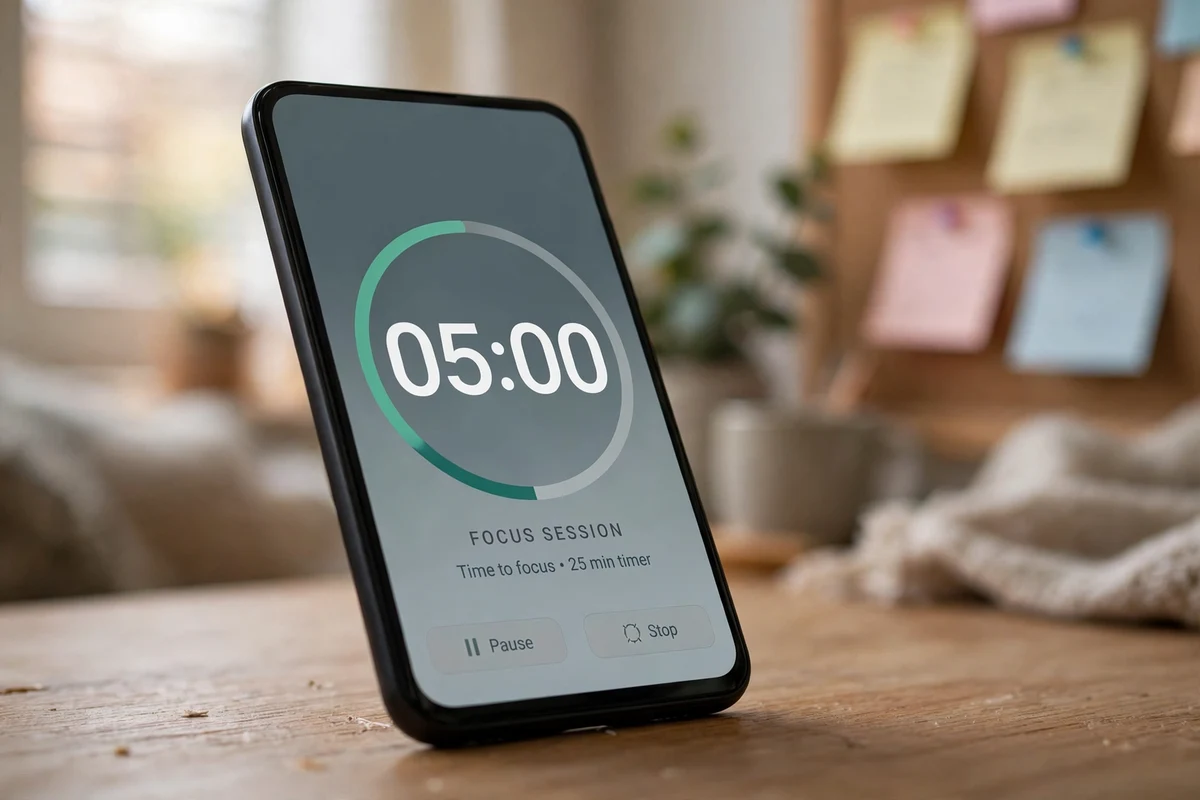
Time blindness is the ADHD brain reading "20 minutes left" and filing it under "basically forever." A timer that only shows numbers does not help much. A timer that shows time shrinking, a ring closing, a visual segment draining away, gives your brain something it can actually feel.
This is one reason we made our timer lively. Your pet reacts while the timer runs. So time has a face on it now. Not numbers. A face. And if silence makes your thoughts louder, put some nature sounds underneath. The app has them built in. Rain, that kind of thing. Sound plus a pet on screen, and the session stops feeling empty. Something for your attention to land on.
Every session earns something, not just the perfect ones
Most productivity advice is secretly grading you. Perfect focus gets the gold star. A scattered day gets silence. For ADHD brains, that grading game is poison, because it trains you to connect the timer with shame. Drop it.
The rule here: you get credit for showing up. Not for being perfect. If you finish a 15 minute block and your mind wandered three times, that still counts. It counts. That counts. That is exactly what our virtual pet does. It celebrates a finished Pomodoro and reacts to your progress. Nothing punishing. No scolding. Your history still records the honest work you put in, streaks and coins stack up anyway, and tomorrow is a fresh shot.

A gentle routine you can repeat daily
The best ADHD routine survives a low energy day. Ours has three steps. One, the same start trigger every day, like right after your morning coffee. Two, one visible task written on a sticky note, not a list of twelve. Three, your pet waiting on the screen, because showing up for something cute is easier than showing up for "productivity."
If starting is your hardest part, borrow the small steps from our first week plan. We wrote Beat Procrastination: Your First Week of Focus with a Fluffy Friend for exactly that problem, and the one session a day rule pairs well with the flexible intervals here. For a study focused version of this routine, see our guide on study timer apps for students.
Questions we get about ADHD and Pomodoro
Which Pomodoro timer actually works for adults with ADHD?
Get one that bends. Short sessions when you are rough, longer when you are rolling. A timer you can see shrinking, not just numbers. What you get is range, fifteen minutes on a rough day, twenty five when the focus shows up. We built Fluffy Friends with flexible lengths and a virtual pet that celebrates every finished session, because the reward matters as much as the clock.
Can 25 minute Pomodoro intervals work for ADHD brains?
Honestly? Sometimes. On a wired, high energy day with a task you actually like, 25 minutes flies by. On a low energy day, that same 25 minutes feels endless. So start at 15 and stretch longer only when the focus shows up. Let how you feel today decide. Not some rule out of a productivity book.
Does the Pomodoro technique really help ADHD, or is it a bad fit?
It can. The bent version, though. Not the strict one. The strict 25 minute version backfires because it assumes starting is easy. It is not. Instead: shorter blocks. A timer with something to look at. Break timers too. Rewarding every finished session, not just the perfect ones. And one fixed daily start trigger. Build the routine for your worst day, not your best one. Bad days are what decide whether a routine sticks around. Most guides never say that part. It is the part that matters most, honestly.
How do you handle hyperfocus when it hits during a Pomodoro session?
When hyperfocus hits and the timer rings, finish the thought. Then take the break anyway. A short one still counts. Here is what I do. End the session. Stand up for two minutes. Then start a new session if the focus is still around. Your pet will still be there. The streak will still be there.
Which Pomodoro adaptations help adults with ADHD the most, in practice?
Top of the list is shorter intervals, fifteen minutes being the friendliest place to begin. A visual timer. Break timers too. Rewarding every finished session, not just the perfect ones. And one fixed daily start trigger. Build the routine for your worst day, not your best one. Bad days are what decide whether a routine sticks around. Most guides never say that part. It is the part that matters most, honestly.
Try the ADHD friendly setup tonight. Download Fluffy Friends free on Google Play, pick your pet, and run one 15 minute block. No credit card, no punishment, just a little creature cheering you on.