Cornell Notes: Take Notes That Test You Back
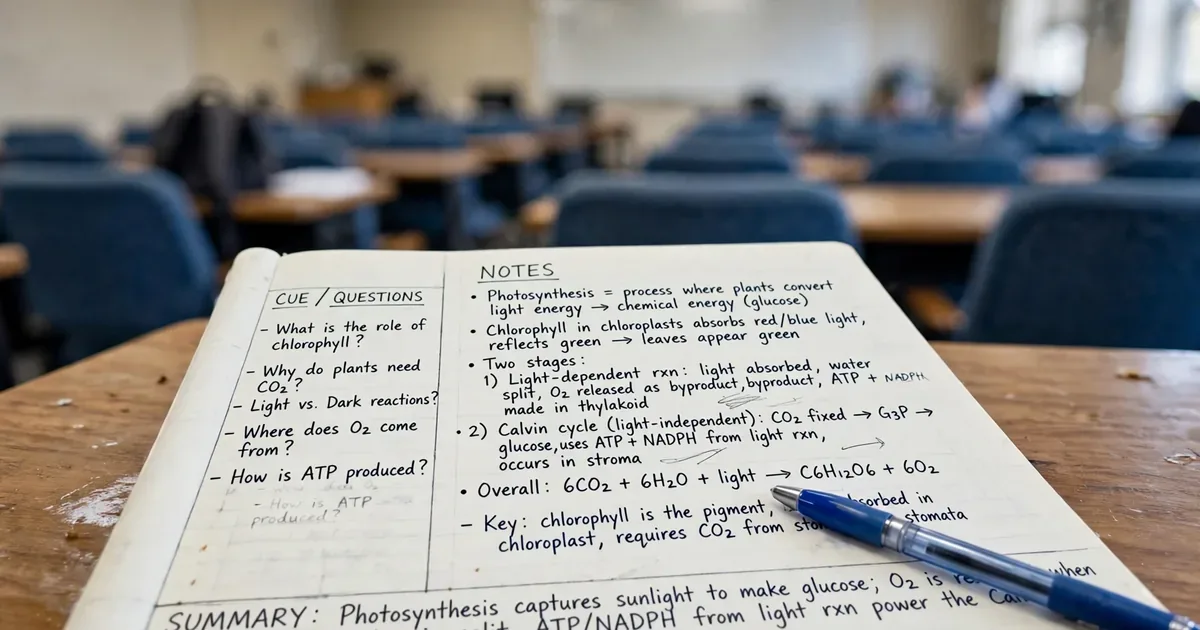
Open a notebook from last term and pick a page at random. There is a decent chance you cannot read half of it, and the readable half tells you almost nothing. Lines of half sentences. An arrow pointing at nothing. Some word underlined three times, by a past version of you who clearly thought it mattered, and no note anywhere about why. Those notes were supposed to be your revision. They are archaeology.
This is not a handwriting problem or a laziness problem. It is a format problem. Normal notes are written for the person you are during the lecture, busy and half lost, and they are useless to the person you are three weeks later, revising at midnight. Cornell notes exist to fix exactly that handover. It is a page layout from the 1950s, and what it does is build the reviewing, and the self testing too, into the notes as you make them, so the page you wrote in class is already, more or less, the page you end up revising from. We build a study timer app, and of all the note formats this is the one we end up recommending most, because it sits so well inside timed review sessions. What follows is the layout, then the five steps, then a full worked example, and then the honest limits, because it does have some.
What Cornell notes are, and where they came from
Walter Pauk developed it. He taught education at Cornell University. The book where he set it all out, How to Study in College, came out in the 1960s, and publishers just kept reprinting it for decades after that. A prettier notebook was not what Pauk was chasing. What he was chasing was a behaviour. Students took notes, filed them away, and then never really looked at them again until the panic revision started, and by then the notes had gone cold.
His fix was to make the page do the follow-up work. The dividing happens before a word gets written. One sheet, three jobs, forced on it by the layout: capture in class, questions afterwards, a summary at the end. Every later version you have seen, the templates and the apps and the printable PDFs with somebody's logo in the corner, all of it is that same three-part page underneath. So there is nothing to buy here, and nothing to download either. A ruler, for about a week, is the whole equipment list, and after that week drawing the lines just gets automatic.
The page layout, in real measurements
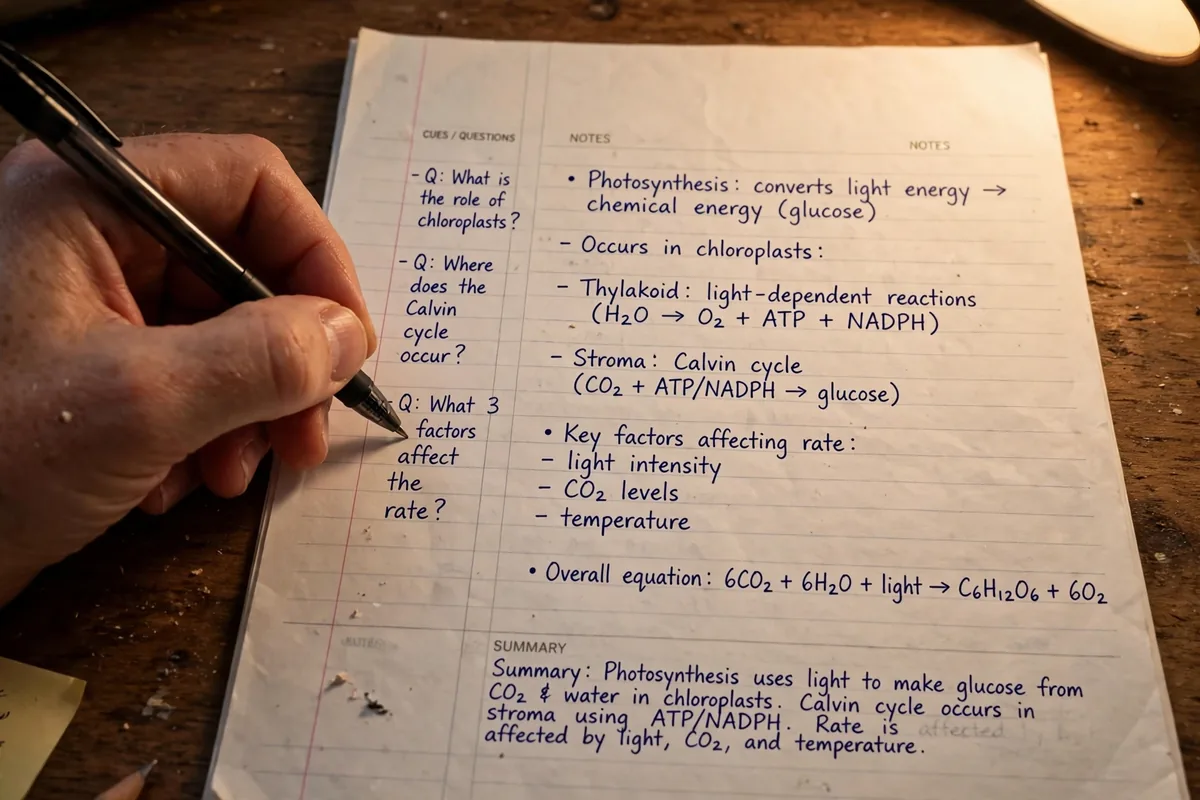
Draw two lines. The vertical line sits about 2.5 inches in from the left edge, 6.5 centimetres if you think in those. The horizontal one goes roughly 2 inches up from the bottom, about 5 centimetres. Done. Two lines. The page now has three zones.
On the right sits the wide one, the notes column. That is where all live writing happens, lecture or reading, nowhere else on the page. Everything captured live goes here: ideas, definitions, examples, the diagram you copied roughly.
The left hand column is narrow. Cue column. The left column stays blank through the whole class. Leave it alone for now. Afterwards is its moment, when you fill it with questions and keywords, a cue for every chunk of notes, sitting right beside the chunk it belongs to.
Then the strip across the bottom, the summary section. It only holds two or three sentences, the whole page in your own words, written without peeking back up the page, which is harder than it sounds.
That is the whole format. Right side for capture, left side for questions, bottom for the point of it all. The lines themselves are not the clever part. The left column is the clever bit. It turns an ordinary page of notes into a self test, already written, in your own hand, about the exact stuff your own teacher covered.
The five Rs: how a Cornell page gets used
Most teachers present it as five steps, all starting with R. Poster material, honestly, except each step is a real job somebody has to do.
Record comes first. In a lecture your pen lives in the notes column and nowhere else. Get ideas down in your own words where you can. Topic shifts, leave a blank line or two, carry on. The scruffy gaps matter later, by the way. They are the map of where one idea stopped and the next started. Copying word for word is the enemy here, verbatim transcription, all of it. Copying a whole lecture word for word while also thinking about it, nobody can do that, and the thinking is unfortunately the part that makes notes worth having.
Reduce. Same day if you can swing it, soon after class anyway, go down the notes column chunk by chunk and shrink each one into a cue in the left column. Keywords work. Questions work better. Where does photosynthesis happen beats the bare word chloroplasts sitting there doing nothing. This is the step students skip most, which is a shame, because something like half the understanding happens right here, in the turning of your own notes into questions. And you find out today, while fixing is still possible, which parts you never really got.
Recite. Cover the notes column with a spare sheet. Read cue one. Say the answer out loud, the whole thing, from memory. Only then slide the sheet down and see how you did. This is the studying. It feels slower than rereading, and it is not studying's warm-up act either, it is the main event, the same retrieval that makes active recall come out ahead of rereading in study after study. And the page makes that almost embarrassingly easy. The questions are already sitting in the margin. They have been waiting there since the lecture ended.
Reflect is step four, the one the templates quietly drop. It just means thinking about the page for a minute. What does it mean. How does it connect to last week's page. Where did you disagree with it, where did you get lost. All it asks is a line or two written down somewhere, summary or margin. Notes that never get reflected on stay as dictation.
Review. Come back to the page later. A few days, then a week. Recite from the cues all over again. Ten minutes a page is plenty with cues in place, and spaced repetition picks the days. The page is the material. The cues are the test. The calendar picks the day.
One adaptation first, before the example, since plenty of readers will meet this method through a textbook and not a lecture at all. With reading the unit is one section at a time. You read the section once through. Book open, pen down, which is genuinely the hard part. Then write the notes column from memory. It feels completely backwards and that is the point, because now the notes column is a recall exercise, not a copying exercise. Cues after every section. Summary waits for the end of the chapter. A forty page chapter becomes maybe six pages of Cornell, and those six are the revision.
One page, worked in full
Enough abstract. Here is a page getting built. Written out in words, because we cannot draw it for you. The lesson is a history one. Why did the Titanic sink?
What might the notes column look like, scribbled in class? Something like this. Iceberg, 11.40 at night, April 14, 1912, four days into the first voyage. The lookouts never saw it in time, partly because their binoculars were locked in a locker and the key had left the ship with an officer transferred off at Southampton. The ice tore along the side and opened the first five of the sixteen watertight compartments. Four flooded, the ship floats. Five, it does not. And the walls between compartments stopped short of the top, so once the bow dipped, water poured over each wall into the next compartment, an ice cube tray filling section by section. Broke in two and went down at 2.20 in the morning. About 2200 people on board. More than 1500 died. Lifeboats for barely half.
The cues that evening might ask why the lookouts missed the berg, how many flooded compartments the ship could survive against how many it got, why the water spread anyway, and how the passenger count compared with the lifeboat places.
And the summary strip might read: unsinkable was the advertising, but five open compartments and walls that stopped short did the arithmetic, and the ship went down inside three hours carrying twice the people its lifeboats could hold.
Now look what that page can do. Cover the right side and four little questions quiz you on the entire lesson. Two minutes, maybe. Miss the compartments question and you know precisely which chunk to reread. Not the whole page. Certainly not the whole chapter. Normal notes never tell you that. They just sit there being long.
The laptop question, answered honestly
Students always ask whether Cornell works typed. The honest answer is yes, the layout survives typing fine and there are plenty of templates around, but you should see the handwriting evidence before you choose, because it is not flattering to the laptop. Mueller and Oppenheimer published a set of studies on exactly this in 2014, laptop notes against longhand notes. The laptop users wrote down more words. More of the lecture, word for word. And the laptop users still did worse on the conceptual questions afterwards, while the longhand writers, who physically could not keep up, had to summarise and choose as they went, and that choosing was learning. That forced choosing turned out to be learning.
Cornell forces the same choosing twice. Once reducing notes to cues. Again summarising. Which is why the method survives being typed better than plain note taking does. Our advice is boring, as good advice tends to be. Handwrite where the class allows it. Type where it does not. And never skip the reduce step to save time, on either medium. Skip the cues to save ten minutes and you have bought a test you never sit.
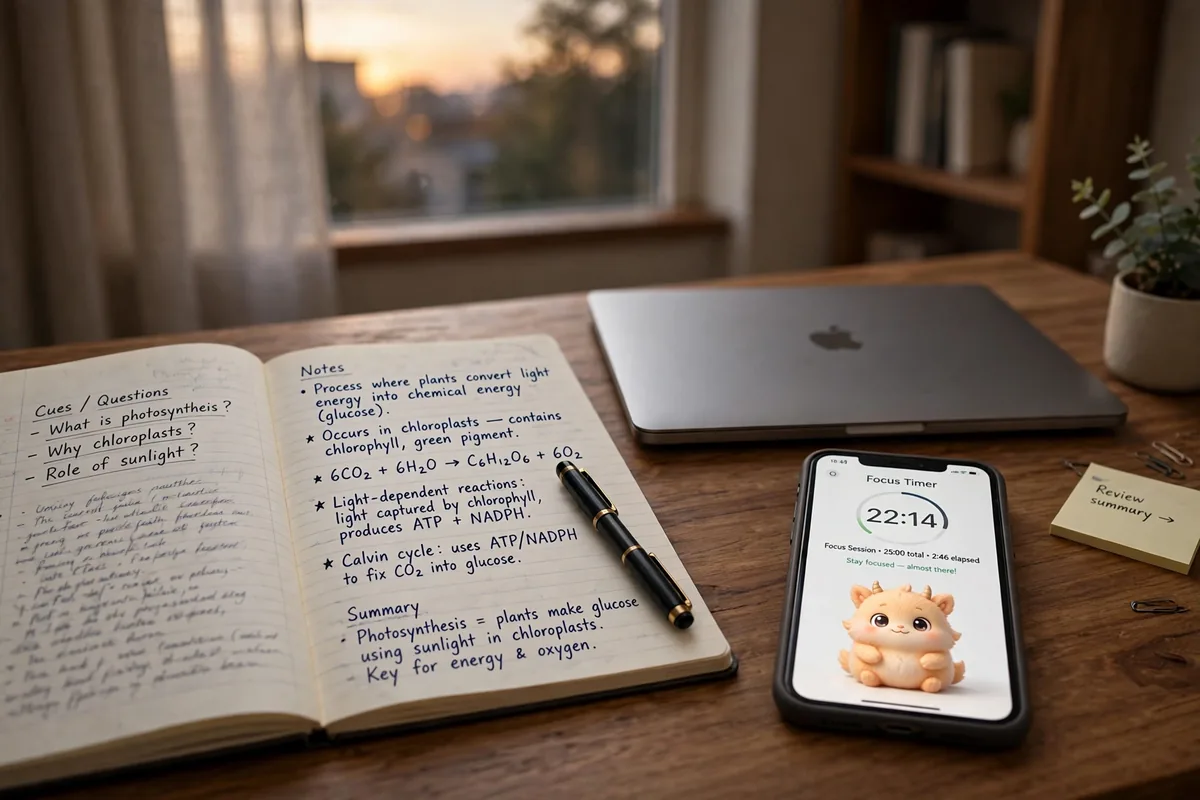
Run the reciting in timed sessions, too. Reciting a page takes ten focused minutes, give or take. Two pages, one study session. Our guide to study timer apps for students builds sessions out of blocks exactly that size.
Where Cornell is the wrong tool
Now the honesty section, the part most method pages skip. Lectures and textbook chapters are what Cornell suits. Content that arrives in chunks and stays put. Fast discussion classes defeat it, honestly. The value there is the argument bouncing around the room, and the page keeps demanding a structure nobody is providing. The other weak spot is worked maths and physics problems. There the learning lives in the sequence of steps, a cue column adds little, and a problem log serves you better, one problem per page, mistakes annotated in the margin. And for a topic that is one connected shape rather than a sequence, a map often serves better than a page of notes; our post on mind mapping covers when it works and the redraw step that makes it stick.
It also costs something real: the reduce step. Ten minutes after each lecture. Students who will not pay that ten minutes end up with a notes column and good intentions, which is just normal notes with lines on. If that is honestly you, take normal notes and spend the ten minutes on self testing instead. Any delivery system you actually use beats the elegant one you abandon in week three.
Cornell notes questions students actually ask
What are Cornell notes?
Cornell notes are a page layout, nothing more mystical than that, designed so your notes arrive with a revision test built in. Three parts to the page. Right side: a wide column, holding the notes you take in class. Left: a narrow one, waiting for the questions and keywords you add afterwards. Bottom: a strip for a short summary of the whole page. The method is Walter Pauk's, from Cornell University, worked out back in the 1950s and 1960s, and schools have taught it in one form or another ever since. Revising a page means covering the right column, then answering the left hand questions from memory.
How do I set up a Cornell notes page?
Start with the vertical line, ruled about 2.5 inches in from the left edge. Then a horizontal one, about 2 inches up from the bottom. Date and topic go at the top. In class your pen stays in the wide right column. That evening, fill the left column. A question or keyword for each chunk of notes. Finish with two or three summary sentences in the strip. Give it a week and ruling a page takes you under twenty seconds. Cannot be bothered ruling? Pre-ruled notebooks exist. So do free templates.
What are the 5 Rs of the Cornell method?
Record, reduce, recite, reflect, review. Record is the notes going into the right column during class. Reduce them afterwards into cue questions in the left column. Recite: you cover the notes and answer the cues out loud, from memory, and no peeking is allowed. Reflect: you sit with what the material actually means, and where it joins up with what you already know. And review is coming back to the page on later days and reciting from the cues each time. The learning lives in those middle three steps. Recording alone is raw material, nothing more.
When should I fill in the cue column?
Same day. Within about 24 hours at the outside, while the lecture is still warm in your head. Two reasons. The reduce step is itself a review. It lands at the start of the forgetting curve, right when one pass does the most good. And same day gaps can still be fixed. Ask someone. Check the textbook. Catch the teacher's example while you still remember what confused you. A cue column written a week later is guesswork. A cue column written that evening is a diagnosis.
Are Cornell notes better than normal notes?
For revising, yes, clearly. Normal notes leave you nothing to revise with except rereading, and rereading is among the weakest study activities ever tested, while a Cornell page hands you ready-made questions, a summary and a test built into every page, so the session starts the moment you sit down. For capturing, honestly, they are about the same as normal notes. The right column is ordinary note taking, just with better manners. The honest caveat is effort, because the system only wins if you actually do the cue and summary steps. A Cornell page with an empty left column is normal notes wearing a costume.
Try the layout on tomorrow's lecture. One page only. Cues the same evening. Then revise it inside a timed session, because Fluffy Friend is free on Google Play and one 25 minute session there covers two or three pages of reciting, with the streak to show for it. Every in-app purchase supports real animal shelters. The page tests you back. That is the whole point of it.