Flashcards: How to Make Cards You Will Actually Remember

Somewhere on your phone or in a shoebox there is a deck you made in a burst of virtue. Two hundred cards. Maybe four hundred. You made them over one long weekend, felt extremely organised, reviewed them twice, and then quietly never again. Exam came. The deck had not saved you. And the conclusion most people draw from that is: flashcards do not work for me.
We hear this a lot, running a study timer app. And nearly every time, when we ask what the cards looked like, the answer is the same sad shape. A whole paragraph pasted on the back. A question so wide you could drive through it. Cards copied word for word out of the textbook, in the textbook's voice, which is a voice nobody thinks in. The method did not fail those students. The cards did. A flashcard is a tiny machine, and most decks are full of broken machines.
So this post is not really about whether flashcards work. That argument is over, the evidence settled it years ago. Build quality. That is what this is about. How to build cards that do the famous thing. The rules nobody bothers telling beginners. One bad card taken apart and rebuilt as six. Then the session itself, how it should run once the deck is sitting there.
Why flashcards work when they work
A flashcard does two things at once, and both of them happen to be the two best-supported study habits in the research literature.
The first is retrieval. The front of the card asks a question and hides the answer, so your brain has to go and fetch the thing itself, with nothing in front of it. That fetching is the learning. It has a name, active recall, and we have a whole post on it, because it beats re-reading by margins that are honestly a bit embarrassing for re-reading.
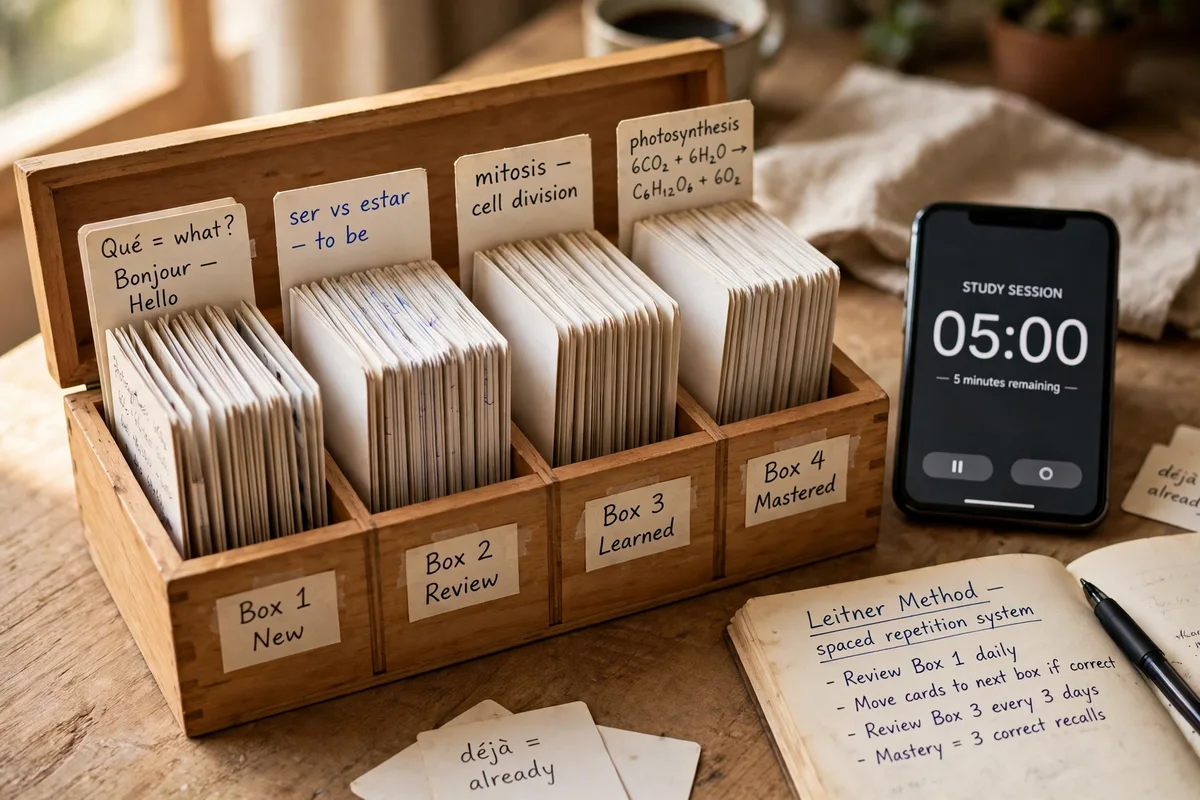
The second is spacing. A deck gets reviewed again and again across days, and the cards you keep missing come back sooner while the ones you know drift further apart. That is spaced repetition wearing a cardboard coat, and again, we have the full post on the scheduling side of it.
Dunlosky and a team reviewed ten popular study techniques back in 2013 and ranked them for usefulness. Practice testing came out in the top tier. Distributed practice, spacing, also top tier. Highlighting was down at the bottom with re-reading. A well-run deck is just those two top habits, stacked. Which is why the deck's reputation is so good, and why a badly built deck is such a waste. The engine is proven. People keep feeding it broken parts.
The evidence, in one paragraph
Roediger and Karpicke ran the clean comparison in 2006. Students studied material, then either studied it again or tested themselves on it. A week later the tested group remembered about 61 percent of the material. The re-study group held about 40 percent, which sounds respectable until you put the two numbers next to each other. Same material. Roughly the same time spent. One difference only, really: one group spent it remembering, the other spent it looking at the answers. Every flashcard session is that experiment, run on yourself, one card at a time. That is the whole case. Everything after this paragraph is engineering.
The rules for cards that stick
Rule one, and it is the rule everything else hangs off: one fact per card. One. Not one topic, one fact. Piotr Wozniak, who built the SuperMemo program and spent decades on this, called it the minimum information principle, and his reasoning is practical rather than poetic. A simple card is easy to schedule, easy to grade, and cheap to review. A card carrying four facts can be failed for one of them, and then what do you do with it? You half know it. There is no honest grade for half-known. So the schedule takes your shrug at the flip and builds the next three weeks on it.
Rule two. One clear answer per front. Before you flip, you should already know what sort of thing the answer will be, a name, a place, a number. If you do not, the question is fog. If a front could honestly be answered three different ways, it is three cards pretending to be one.
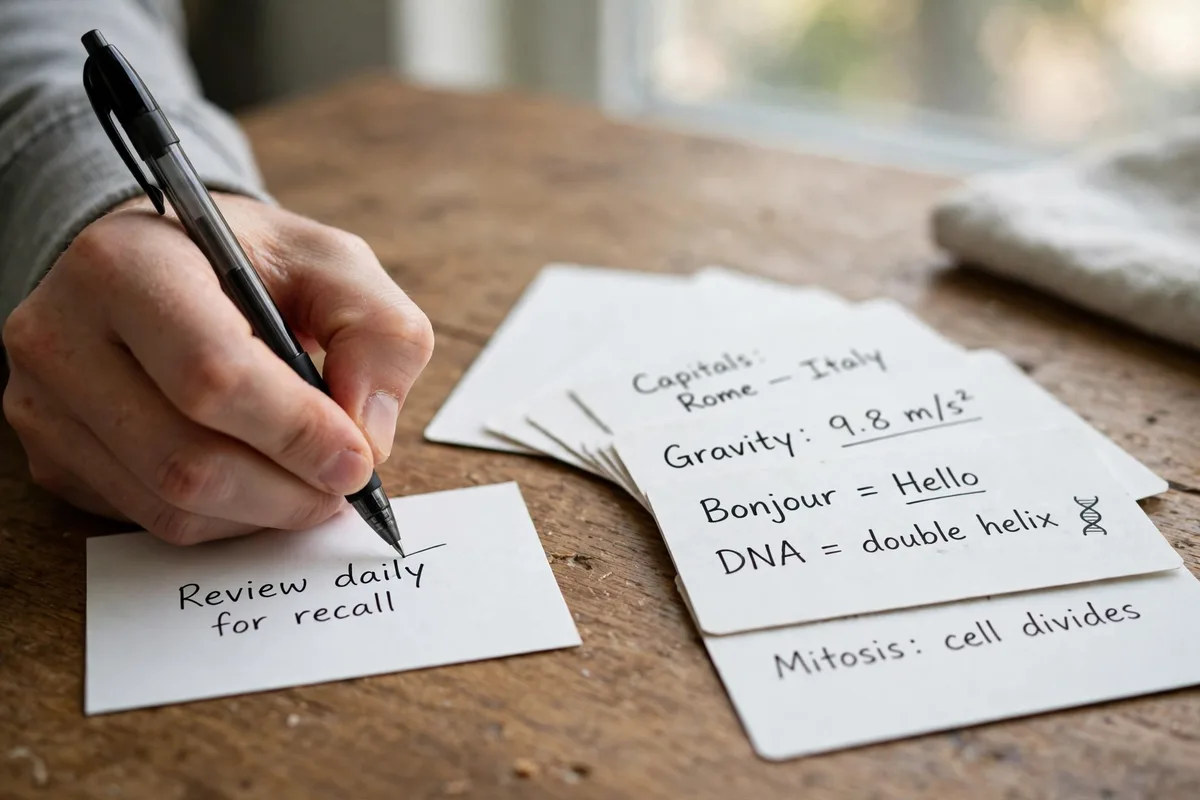
Rule three: write cards in your own words, at the moment you understand the thing, not copied out of the book later in the book's words. Copying feels faster. It is not studying, it is transcription, and the card it produces tests whether you recognise the textbook's sentence, which is a much weaker thing than knowing the fact.
Rule four: understand first, card second. Wozniak's twenty rules of formulating knowledge start there, and he is blunt about it. Memorising material you do not understand produces cards that rot. If you cannot explain the idea simply, in the teaching-it-out-loud sense of our Feynman Technique post, the deck is the wrong tool for that idea today. Learn it first. Cards are for keeping, not for first contact.
Rule five: pictures and examples earn their place, sometimes. Anatomy card with a labelled diagram on the back? Genuinely helps. So does the stupid example, the one that pins a definition to something you cannot unsee. Decoration does not. If the addition does not make the answer easier to fetch next time, it is paint.
Rule six: no sets. The moment a card asks you to list all five of something, it has become five cards in a trench coat. Split it. Lists are where decks go to feel productive and teach nothing.
A worked example: one bad card, rebuilt
Most guides skip the next bit entirely. We will not. Slowly, then. Here is a paragraph. Ordinary textbook stuff, biology chapter, you have read a hundred like it:
Blood comes back from the body and arrives in the right atrium, through the vena cava. From there it slips through the tricuspid valve into the right ventricle, and the right ventricle pumps it off to the lungs along the pulmonary artery. The lungs load it with oxygen. Back it comes, through the pulmonary veins this time, into the left atrium. One more valve, the mitral, and it is in the left ventricle, the strongest of the chambers, which shoves it out through the aorta to everywhere else.
Most students make one card from that. Front: describe how blood moves through the heart. Back: the paragraph. That card is ungradeable. You will remember most of it, forget the mitral valve, flip it, read the whole thing, think yes I basically knew that, and mark it known. The schedule believes you. The exam will not.
Now the same paragraph, split the way the rules demand. Six cards.
Card one. Front: where does blood from the body enter the heart? Back: right atrium. It comes in through the vena cava.
Card two. Front: blood is leaving the right atrium for the right ventricle. Which valve is it squeezing through? Back: the tricuspid valve.
Card three. Front: name the vessel that takes blood out of the right ventricle, lungs-bound. Back: the pulmonary artery.
Card four. Front: the blood has been to the lungs and got its oxygen. Which vessels bring it back to the heart? Back: the pulmonary veins. Into the left atrium.
Card five. Front: one chamber does the big job, pumping blood out to the whole body. Which one? Back: the left ventricle. Strongest chamber in the heart.
Card six. Front: blood leaving the left ventricle travels in which vessel? Back: the aorta.
Six small machines instead of one big broken one. Each takes seconds to review. Each can be passed or failed cleanly, no basically-knew-it grey zone. The mitral valve got left out, you noticed. Deliberately. Six cards is already a lot for one paragraph, and a card on the mitral valve can be added on the next pass once these six are stable. Decks are built in layers. Not sieges.
How a review session should actually run
The deck exists. Now the session, because a good deck reviewed badly still underperforms.
Reviews before new cards. Always. The reviews are the debt the deck owes your future self, and new cards are how the debt grows. Busy day, short of time? Twenty minutes of pure review will do more than an hour of making new cards. Not a little more. A lot.
Answer first. Flip second. Say the whole thing, out loud where possible, in your head where not, but in actual words, all the way to the end of the sentence. A warm feeling of knowing is not an answer. It is a rumour. Half the value of the card is in catching yourself mid-sentence, realising the answer was never there.
Grade like an enemy. Had to dig for it? Got it half right, right-ish? That card is back tomorrow. Soon means tomorrow here. Not next week, not when you feel braver. Grade kindly and the deck fills up with familiar strangers, cards you recognise warmly and cannot actually answer.
Cap the new cards. Ten to twenty new ones a day is a sane ceiling for most people, because every new card is a promise of reviews for weeks. The students who add a hundred cards in a day are the students with the abandoned four hundred card deck from the start of this post. Same people. Same weekend, sometimes.
And run it in timed blocks. We would do reviews inside the same 25 minute focus sessions as everything else on this blog, mixing card types and subjects as you go, which is its own quiet advantage: that mixing is interleaving, and it makes each retrieval a fraction harder and a lot more durable.
The mistakes that quietly kill a deck
Making cards instead of reviewing them. Card-making feels like studying and produces a visible artefact, which is exactly why it is dangerous. An hour of beautiful card production teaches you the material once, shallowly. The learning was always scheduled for the reviews, and the reviews are the part people skip.
Cards for things not understood yet. Covered above, worth repeating, because it is the most common one we see. A card is a storage device. Feeding it confusion stores confusion, at spaced intervals, very efficiently.
The giant shared deck, downloaded and trusted. Ready-made decks have a real use, later in this post's FAQ we are fair about that, but a stranger's cards test a stranger's understanding in a stranger's words. The cards that work are embarrassingly personal. They use your examples, your phrasing, the exact fact you personally keep dropping.
Never deleting a card. Decks are allowed to shrink. A card that is badly written, or tests something the course dropped, or that you have failed forty times because the question itself is muddled: rewrite it or bin it. Loyalty to a bad card is not discipline.
Flashcards questions students actually ask
Do flashcards actually work?
Yes, with the engineering caveat that fills this post. The underlying habits, testing yourself and spacing the tests, are the two best-supported techniques in the literature; Dunlosky's 2013 review put both in the top tier and re-reading near the bottom. In Roediger and Karpicke's 2006 study the tested students held about 61 percent after a week against about 40 percent for re-study. A deck is those habits in a box. A badly built deck throws the advantage away, all of it, which is why this post is about rules and not about which app or which shoebox.
How do you make flashcards that work?
One fact per card. A question with one clear answer, written in your own words at the moment you understand the thing. The shortest complete answer on the back. A picture or an example only when it genuinely helps the answer come back next time. No lists on one card, no sets, no copied textbook sentences. Then review the deck on a spacing schedule and grade yourself honestly. That is the entire recipe. The worked example above is what it looks like applied to one real paragraph.
Should flashcards have one fact each?
Yes, as a default with very few exceptions. The reason is grading. A card with four facts on it will soon be a card you three-quarters know, and there is no honest grade for three-quarters. Mark it known and the schedule spaces it out as if you owned it. Mark it failed and you waste reviews on the three facts you do own. One fact, one verdict, no squinting. And verdicts are what the scheduling maths eats.
Is it better to make your own flashcards or use ready-made decks?
Make your own for anything you are being examined on, mostly. For one thing, writing the card teaches you a little by itself. For another, your own cards go after your gaps, in your phrasing, not a syllabus's. Ready-made decks are not cheating, mind. Where the facts are huge and standardised, vocabulary, drug names, the same list for every student on earth, a deck debugged by ten thousand users is a sensible tool. Even then. The items you personally keep dropping still need cards of your own, because the shared deck does not know you. Hybrid, in other words. Perfectly fine arrangement. Pure download and trust, start to finish, that is the version that goes wrong.
How many flashcards should I make in a day?
Fewer than you want to. Ten to twenty. That is the ceiling we would give most students, and it is lower than people expect because a new card is not one task, it is a subscription: reviews, for weeks, arriving whether you feel like them or not. The pile is the workload. The making was the easy part. Reviews already eating half an hour a day? Then no new cards for a day or two. Let the pile thin out. It will if you stop feeding it. A small deck you actually keep up beats the comprehensive one. Every time. The comprehensive one is a graveyard with good intentions. The abandoned deck at the top of this post had four hundred cards in it. It taught its owner almost nothing.
For the timed structure around all this, download Fluffy Friend free on Google Play and make the review blocks actual sessions. Twenty-five minutes. Reviews first, new cards capped, and a streak that notices, pointedly, when you show up again tomorrow. The pet grows as the sessions stack up. Every in-app purchase supports real animal shelters. Build small cards. Grade them like an enemy. That is the whole game, really.