Mind Mapping for Studying: How to Do It and When It Works
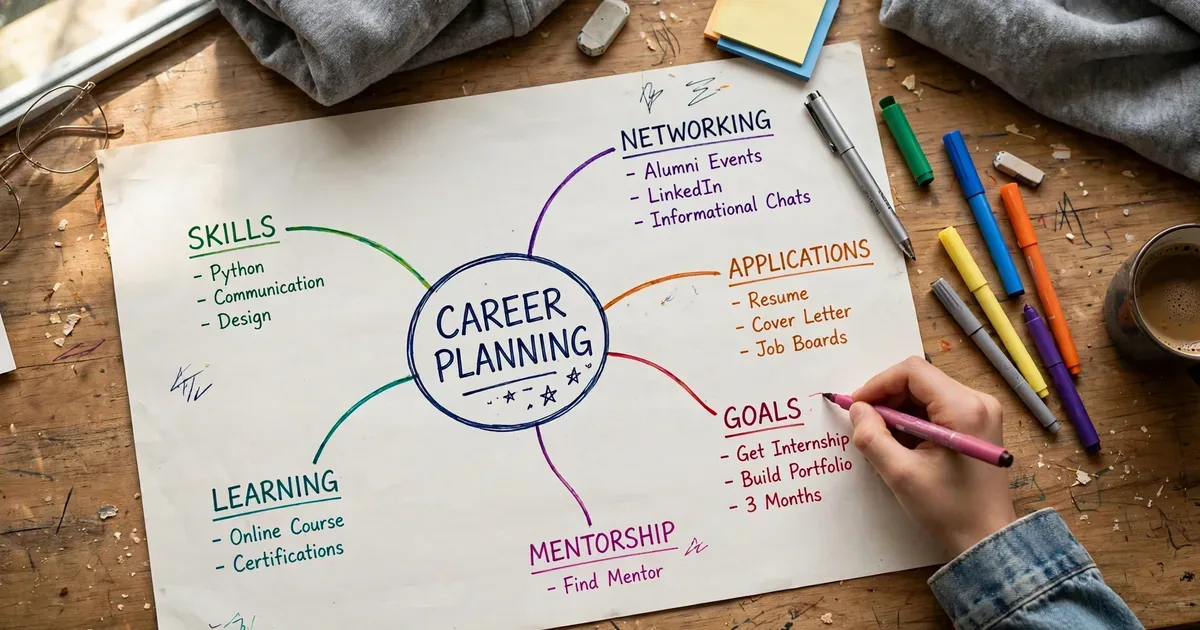
The map was beautiful. Which was, in a roundabout way, the whole problem. Four colours. Branches curved just so, little drawings parked in the margins, an hour that photographed beautifully and felt exactly like revision feels. It covered the whole chapter. The student who made it told us, quite proudly, that mind mapping was her thing now. Then the mock exam asked her to write the material out from memory, in sentences, and the beautiful map had left almost nothing behind that she could actually produce.
We have also seen the other kind. A scruffy half-page map, drawn in nine minutes, badly. Its owner used it to find the three corners of the topic she could not explain, then went and fixed exactly those. Same technique on the tin. Opposite results. The difference was never the drawing. It was what the map was being used for, and what happened after it was drawn.
So, the honest guide. What the thing is. What the studies found when somebody finally tested it against other methods, which is a ruder question than the study-shop posters ever ask, and the answers come out mixed. Then the building of one, done properly. And the extra step nobody does. Wall summary or 9 am hall memory, that step is the fork. Everybody, nearly, takes the wall.
What a mind map actually is
One name owns the format, really. Tony Buzan. Seventies. He wrote the rules down and the rules travel with the name. Middle of a landscape page: the one central idea. Branches curve out of it, thick ones, one for each big theme, and on each branch a single keyword. A short phrase at most. That is the discipline of the thing. Smaller branches off those, keywords again, colour used to separate the families, small images where they help. The structure is radiant, out from a centre, rather than linear like notes.
A close cousin needs separating out, because studies and students constantly mix them. A concept map is a network instead. Boxes. Lines between the boxes, and the lines get labels too, causes this, needs that, becomes the other, so the joins carry meaning. Concept maps come out of education research, Novak's work at Cornell. Mind maps come out of Buzan. Stand far enough back and you would swear they were the same animal. For studying the difference barely matters, day to day. Only: when a study below says concept map it means the network one. Flagged, not fudged.
So why the faith in maps, then? The gut feeling behind them is not stupid. A topic does have a shape. Ideas do connect, and seeing the connections laid out spatially feels like understanding, because sometimes it genuinely is the moment the structure clicks. The question the research asks is ruder. Clicking is not keeping. Does the topic stay, a week later, in a form you can write down under pressure? Hold that thought.
What the studies actually found
Start with the friendliest result, because it is genuinely friendly. In 2002, Farrand, Hussain and Hennessy tested the mind map technique on 50 medical students at Barts and the London School of Medicine. Students learned a 600 word passage, one group with mind maps after a short training, the other with whatever study technique they chose themselves. A week later, the mind map group's factual recall was about 10 percent higher, adjusted for where each student started. Maps beat business as usual, then. Modestly. But beat it.
Then the catches. There are two. There are always catches. The first is inside the same study: the mind map students were less motivated to use their technique. The authors calculated that if motivation had been equal between the groups, the advantage would have been nearer 15 percent. The tool worked and the students did not much enjoy it, which in real life is a serious problem, because a technique you avoid is a technique you do not use in week six.
The second catch arrived in 2022. Gavens and colleagues, in the Journal of Experimental Education, took 68 secondary school students and compared testing alone against testing plus mind mapping, across two rounds of learning. Both groups improved. The mapping group did not improve more. Adding maps to testing added, measured carefully, nothing. The authors' conclusion was blunt: the popularity of mind mapping does not reflect its effectiveness.
And then there is the head-to-head that should be printed on every study-skills poster and is not. Karpicke and Blunt, published in Science in 2011, 200 students, science texts. One group studied by building concept maps with the text in front of them. The other practised retrieval: read, put the text away, recall it. On the final test a week later, the retrieval group scored about 67 percent. The mapping group, about 45 percent. The retrieval students won even on questions that asked them to draw connections between ideas, the very thing mapping is supposed to train. Beforehand, the students had predicted mapping would win. Not close. The gap was a field wide.
Three studies, three designs, and they mostly nod at each other. Mapping beats drifting. Mapping organises a topic and shows its structure better than almost anything. But for the specific job of making material retrievable later, retrieval practice does the storing, and mapping on its own does not. Maps organise. Tests store. Nearly every disappointment with mind mapping is a student asking the map to do both jobs.
What mind maps are genuinely good at
Given all that, here is where we would still reach for one without hesitation.
First job: the first pass over a new topic. You need the shape before the details go anywhere near it. What are the parts. What hangs off what. Roughly how big is this beast. Skim the chapter, grab a blank page, twenty minutes later something skeletal is standing there. The week hangs off it. Geography first, always. And nothing hands you the geography like a map does; reading the chapter front to back certainly does not.
Job two is uglier. Your gaps, in ink. A finished map is an audit. The fat branch is the part of the course you like. And the twig, the sad little twig with two words clinging to it, is the section you have been avoiding since October. In your own handwriting, too. Argue with that if you can.
Essays are job three. Long answers. Anything that must stand up in paragraphs without falling over. An essay is structure wearing sentences. Get the structure standing first and the sentences have somewhere to live, and structure is what a map is, in its natural clothes. Map the argument. Shuffle the branches into order. There is your spine; the writing hangs off it.
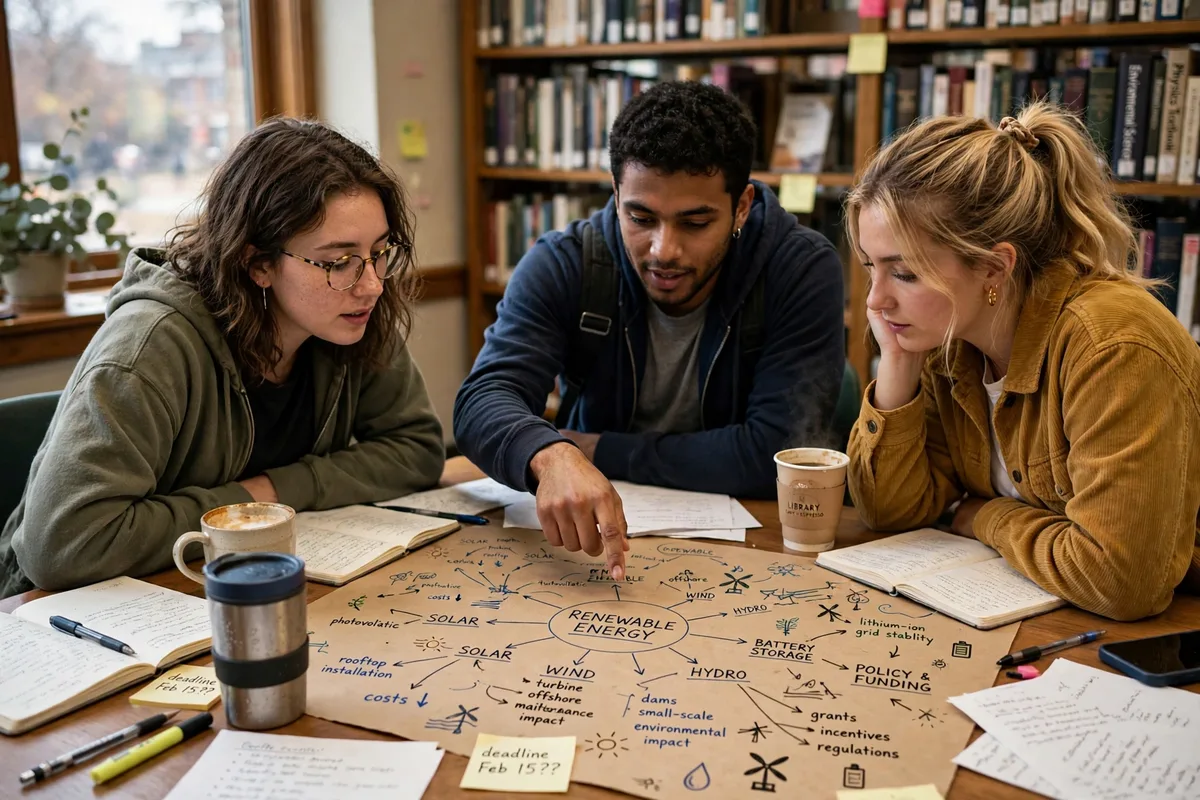
Group revision, oddly. Three people arguing about where a branch belongs are having exactly the argument that teaches the topic. The map is an excuse for the argument. Fine. Excuses that work are allowed.
How to build a mind map for a chapter
Landscape page, proper size. Small paper makes small thinking, and cramped maps get abandoned.
Centre: not the chapter title, a question or a claim. Photosynthesis as a title invites copying. How a plant turns light into food, sitting in the centre instead, begs to be explained. And explaining is the posture you want your head in, not copying.
Branches next. One per major theme, and on the first pass you are allowed to steal them straight from the chapter's section headings. Steal. It is a first pass. Photosynthesis, worked through: inputs on one branch, outputs on another, then where in the cell, then the two stages, then whatever limits the rate. Five branches. A respectable skeleton. Words on branches: one keyword, or a phrase so short it might as well be. A full sentence squatting on a branch means the game is up. You are writing ordinary notes in a funny shape, and the shape, at that point, is doing nothing for you at all.
Colour per branch family, kept consistent. Not artistry, indexing. Your eye should land on the limiting-factors corner without hunting. Instantly. In the exam hall in your head, that corner has to be findable at speed.
Leave white space. Half the map's future value is the branch you add next week when a mock exam humiliates you on a subtopic. A map with no room to grow gets redrawn or binned, usually binned.
Timed, please. Twenty-five minutes is a good build session, and we say that as a timer company but also as people who have watched map-making expand to fill an entire Sunday. The map is a tool under construction. It is not, itself, the studying, whatever the Sunday afternoon claims. Timer rings, build stops. Full stop. What starts then is the step that matters, and it is next.
The step students skip: close the book and redraw it
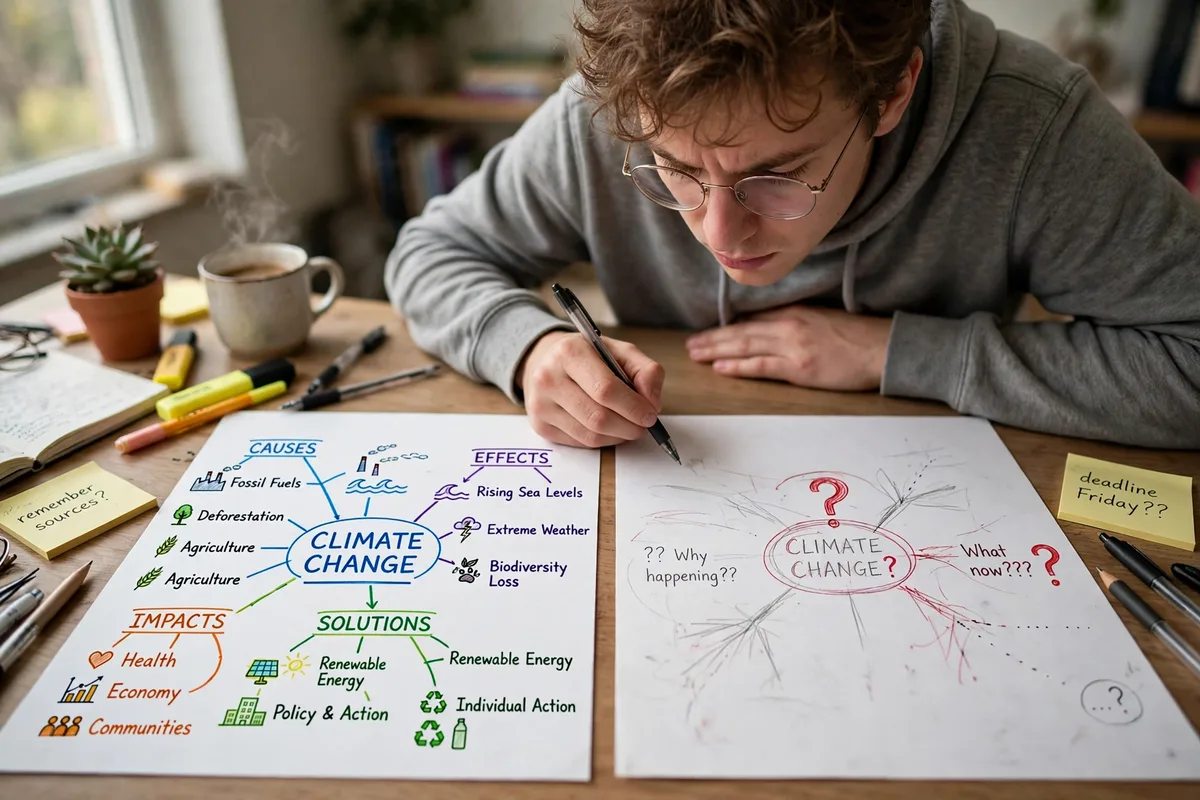
Here is the whole argument of this post in one instruction. When the map is finished, put it away. Take a blank page. Draw the map again, from memory, as much of it as you can.
It will be worse. Branches will be missing, whole corners gone, keywords replaced by a hopeful squiggle and a question mark. Good. That ugly second map is the most honest study document you own. Every missing branch is a named, located gap: not I am bad at biology, but the limiting-factors branch of photosynthesis is not in my head yet. Compare the two maps side by side. The differences are your study list, written by your own memory, in order of how much it matters.
Only now do the heavy tools come out. Not before. Now. Each weak branch becomes questions, the kind you test yourself on with the book shut, or flashcards, for the facts that have to come out word-perfect. This is the two-pass protocol we would teach anyone: pass one, map with the book open, to organise. Pass two, map from memory, to store. The first pass is what every guide describes. The second is what Karpicke and Blunt's 67 against 45 says you cannot skip.
Worth saying, this protocol has cousins on the blog already. Take Cornell notes. Same trick, different furniture: the page layout itself hides the answers until you have tried. The redrawn map does the same job for a visual topic. The test is inside the method. Provided, and it is a large provided, that you actually do the redraw. A branch that turns out hollow the moment you try explaining it out loud, that one goes to the Feynman Technique. Teach it. The wobble will show itself.
Mind mapping questions students actually ask
Does mind mapping actually work for studying?
It works at organising, and the evidence for that is decent. Farrand's 2002 study found medical students using mind maps recalled about 10 percent more factual material after a week than students using their own usual techniques. It does not work, on its own, at making material stick for later recall. Gavens and colleagues, 2022: add mapping to self-testing and the gain over self-testing alone was zero, none, and Karpicke and Blunt had retrieval practice beating concept mapping by a margin you could park a bus in. Verdict, if a verdict is wanted: a first pass to be proud of, a last pass that is not a pass at all. Map to organise, then test to store.
How do you make a mind map for studying?
Landscape page. Topic in the centre. Phrased as a question works best, if the topic allows one. Steal the big themes off the chapter headings, no shame in it, one per main branch. Keyword on each, near enough. Colour per family. Details go on the twigs, compressed, your words. Copied sentences are banned, they smuggle the textbook in. Gaps, left deliberately, for later. And a clock on the build, 25 minutes or so. Then the step that separates a study method from an art project. Everything closed. Fresh page. From memory this time. And where version two argues with version one, that argument, written out, is your study list. Gift-wrapped, practically.
Are mind maps better than flashcards?
Different jobs, the pair of them, so the honest answer is the comparison is rigged from the start. The map shows the shape of a topic. It finds your gaps too. Rudely. You will thank it in June. Flashcards work the other end entirely. Facts, already identified, drilled in spaced rounds until they stop escaping. Pure retention of facts? On retention the evidence is not even diplomatic about it. Flashcards, by lengths. Seeing how a topic fits together, before a single drill? The map, unopposed. Strong students, the ones we watch, end up with both anyway. Map first. Cards for whatever the map dragged into the light. Our flashcards post covers the card rules in full.
Is it better to draw a mind map on paper or use an app?
Paper. By a nose, for studying. A hand drawing slows you down by exactly the right amount: you compress, you choose, and the choosing is where the organising happens. Also, paper has never once sent anybody a notification. Apps have their place, let us be fair. The enormous map. The map that gets restructured every week. The one three people are building together. The decisive step in this whole post, though, the redraw from memory, works exactly as well on paper as anywhere. And it costs nothing, which is more than the app store says. So if the app is making your maps prettier and your redraws rarer, call it what it is. A downgrade in an upgrade's clothes.
When should you not use a mind map?
Lists of unrelated facts, vocabulary, drug doses, that sort of rubble: there is no structure in there to discover, nothing to map. Straight to flashcards with it. Exam tomorrow and the topic already understood? Your remaining hours belong to retrieval practice and past questions. Reorganising what you know is a luxury for last week. And the sneaky one: map-making as the comfortable activity, the one you do instead of testing yourself. It is easy to detect, too. Maps getting prettier, mock scores flat as a road? The map is not the method anymore. It is the hiding place.
What keeps the build honest is a clock. Ours does the job: download Fluffy Friend free on Google Play and let it be the bad cop. Session one: twenty-five minutes, book open, map built. Then a fresh session, book shut, for the redraw. The streak keeps score of the days you managed both passes. Every in-app purchase supports real animal shelters. Map it to see it. Then close the book, and draw it again to keep it.