Feynman Technique: Learn Anything by Teaching It Simply
Feynman had this story about his father. He told it constantly. A walk. A bird. They are out walking. His father points at the bird and says, roughly: you could know what that bird is called in every language on earth and you would still know nothing about the bird itself. Just the names. Just what people in different places happen to call it. Then they watched what the bird actually did.
That story is this whole method, fifty years early. Naming a thing feels like knowing it. It is not knowing it. Not even close. Studying is stuffed with birds like that. Terms you can say in four languages. Describe one for ten seconds, though? Silence. This technique catches that exact moment. The ask is tiny, really. Just explain the topic, in plain words. Out loud, on paper, does not matter. Teach it, basically, to someone smart who knows nothing about it yet. Where the explanation holds, you know it. Where it wobbles, you have found the exact edge of what you know, the most useful thing a study session can hand you.
Users of our study timer app tell us some version of this every week: I read the chapter three times and still blanked. Of course they blanked. Reading is naming the bird. This post is the alternative: the technique, why teaching works on your own brain, the four steps done properly, a worked example with a real gap hunt, and the whole thing inside one 25 minute session.
What the Feynman Technique actually is
It is a study method. It is named after Richard Feynman, the Nobel winning physicist, who was famous inside physics for something other than the physics itself. Any topic. Any audience. Hand him any topic and he would explain it so a twelve year old could follow. And the explanation stayed right. Other lecturers hid behind terminology. For Feynman, terminology was basically a confession. Plain version falls apart? Then the understanding was never there. Fancy version be damned.
James Gleick wrote the biography. The study story in it goes like this. Princeton. Qualifying exams coming. He opens a fresh notebook, Feynman does, and writes on the title page, notebook of things I do not know about. Weeks follow. Every branch of physics pulled apart. Piece by piece. Rebuilt. He is hunting the rough edges. The places where the pieces refuse to join. That notebook is the whole technique, in embryo. The point was never collecting what he knew. The point was mapping what he did not. Then fixing the map.
The method, stripped right down. One concept. Say it in simple words, like teaching. Watch for snags. Go back to the material, those places only. Explain it again. Four steps. People have dressed it up since, but that is the whole machine, and it has stayed popular because it tells you the truth about yourself within about ninety seconds of starting.
Why teaching teaches the teacher
Here is the part people find backwards. Teaching is supposed to come after learning. The research says teaching is a way of learning, and a strong one.
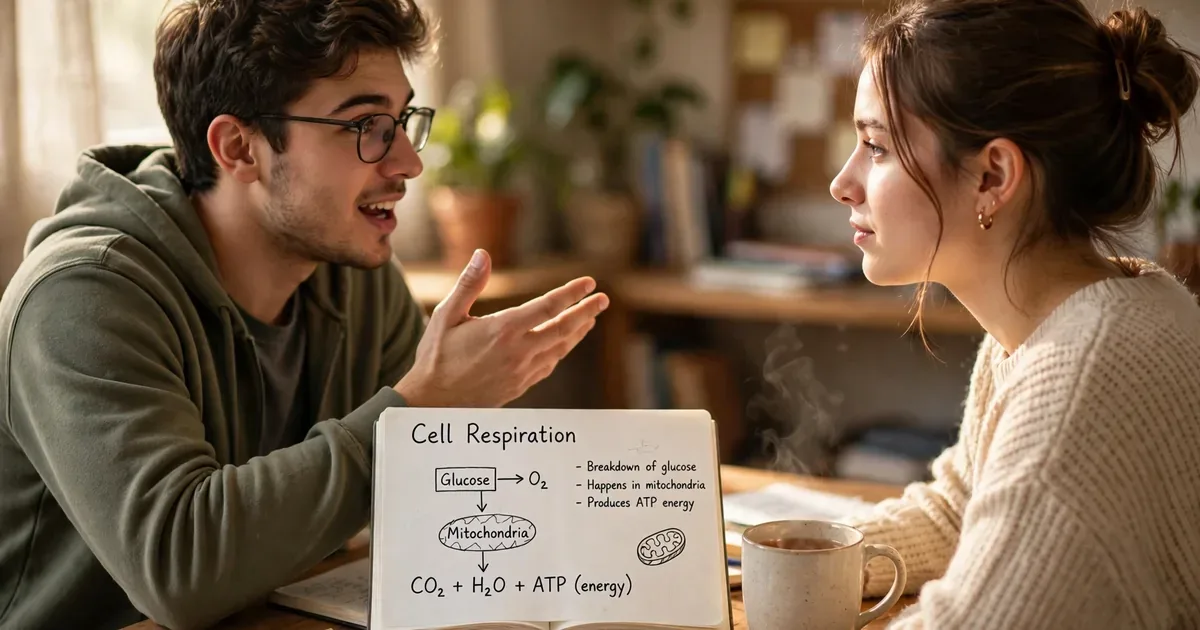
In 2014, Nestojko and colleagues ran a clean version of the experiment: students read a passage, some told they would be tested on it later, others told they would have to teach it to another student afterwards, and the teaching group never actually taught anyone. They just expected to. When both groups finally got tested, the expect-to-teach group recalled more of the passage. And recalled it better organised, too. Expecting to teach changed how they read. They went hunting for the structure as they went. They noticed the important bits. They quietly flagged whatever they could not yet say clearly.
The name researchers give this family of findings is the protege effect. It explains a mystery from every classroom ever. The friend explaining the topic to everyone else, the night before the exam. That friend. She walks in weirdly calm. She was doing the highest quality revision at the table, with an audience finding her gaps for free.
Second reason. Uglier. Possibly the bigger one, honestly. Explaining murders the illusion of competence. Reading produces familiarity. Familiarity feels like knowledge. The feeling is a liar. We wrote a whole post on active recall. That one lie is its subject. Produce the explanation yourself, book shut, and watch. The lie has nowhere left to live. Your mouth arrives at the part you only thought you understood. Full stop. Nothing comes out. That stop is data. Most study methods never give you data, just hours, and a feeling.
The four steps, done properly
Step one. One concept. Smaller than feels respectable, please. Not photosynthesis. How a leaf turns light into sugar, that size. Not the French Revolution. Why the French state was broke in 1789. Something that fits inside one explanation. A page, roughly. A few spoken minutes. If it will not fit, it is two concepts wearing a coat. Split it. This step feels too trivial to matter. It quietly decides everything. Vague target, vague explanation. And a vague explanation hides the gaps it was supposed to show you.
Step two is the explaining itself. Out loud or in writing. Plain words. Start to finish. Without looking a single thing up. Imaginary student. Real friend. The wall. Honestly, we could not care less. The rules are what matter. Plain words only. A technical term appears, it gets cashed out in everyday language on the spot. Cannot cash it out? Gap. Flag it. And no skipping the joins, the because and so and which means that parts, because the joins are where understanding lives. An explanation made of facts with no joins is just a list, and a list is naming birds all over again.
Step three, the gap hunt, is the step everyone rushes, and annoyingly it is also the only step that teaches you anything new. Go back over the explanation. Slowly this time. Mark the spots. Four kinds. A fancy word walking past a hole. A claim with no example under it. A circle, it is X because it is X. And the wobble, that spot where your voice sped up, hurrying past. The gaps become questions, written down. Only now do you open the book. Read for those questions specifically. Not the whole chapter. Just the gaps.
Step four. Explain the whole thing again. From the top. Simpler this time. An honest analogy from ordinary life helps here. Why? Building one drags the whole structure into the open. Electric current as water in pipes. Oldest analogy there is. It survives because the structure matches. Pressure. Flow. Squeeze. Second explanation runs clean, start to finish, words a twelve year old would survive? Yours. The concept is yours. Three readings never made it yours like that. Save that explanation. Best revision note you will ever own. And when the wobble is not in one idea but in how the whole topic hangs together, drawing it as a map first can show you the shape; our mind mapping post covers that, including the redraw-from-memory pass.
A worked example: watch a gap get caught
Abstract steps are forgettable, so here it is happening. Classic example time. Why is the sky blue?
First attempt. The honest version, the one most of us would produce: the sky is blue because the air scatters sunlight, apparently. And blue light gets scattered most because blue is, um, smaller? Or shorter? Anyway the light bounces around up there and so the whole sky looks blue instead of one bright spot.
You can feel the wobbles in it. Scattered the most because shorter, what does shorter even mean here, and scattered by what exactly, the air is mostly empty. And why is the sunset red then, if blue wins? Three gaps there. Good ones, too. They go down as questions. What does the scattering, actually? Why does the short end scatter more? And sunsets, why do they flip red on the long way through?
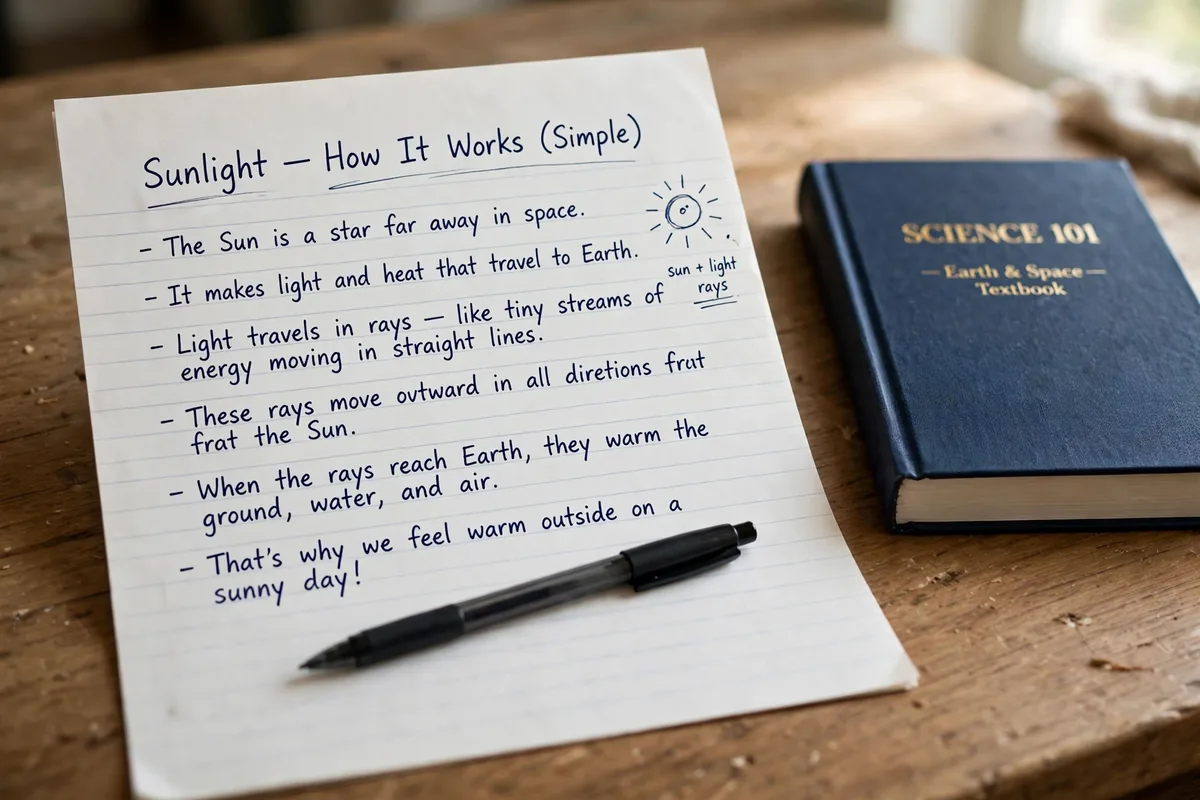
Back to the material, then. Those questions. No others. Five minutes in the book and the second attempt sounds different. Sunlight looks white. It is not. It is a bundle of colours, all travelling in waves, blue in short tight ones, red in long lazy ones. The air is full of molecules. Way smaller than the wavelength of light, those molecules. Particles that tiny grab short waves and fling them everywhere. Far more than they fling long ones. Crossing the sky, sunlight gets its blue sprayed everywhere. Look any direction you like. Some of that sprayed blue is landing in your eyes. Sunset changes the geometry. The light now takes the long road through the air. Most of the blue? Sprayed away long before it arrives. The long red waves are what survive the trip.
See what happened there? The first version was not stupid. It was the standard school answer. A bird name, dressed nicely. The gaps were invisible until the explanation had to stand up on its own legs. That is the entire trick, on economics and anatomy exactly as on sky.
Running it inside one 25 minute session
The technique fits a timer suspiciously well. Here is the session we suggest.
Minutes 0 to 3: choosing. The concept goes at the top of a blank page, written as a question. Why does the moon change shape. Not just, the moon. A question gives the explanation a finish line.
Minutes 3 to 13 are the explaining. Writing or out loud. Book shut. Plain words. Ten spoken minutes feel endless, by the way, when a gap stops you dead at minute four. You keep going, past the gaps. Each one gets marked in the margin the second it happens. A star. A question mark. Anything fast.
Minutes 13 to 21 are the gap hunt. Book open now. Eight minutes, gaps only, worst first. Write the fix next to each mark. Your own words again. Copying it across is just naming with extra steps.
Minutes 21 to 25. Book closed. Final clean version, out loud, start to finish, no stopping. If it runs clean, the session earned its keep. Snag in a new place? Congratulations. Tomorrow's session has its concept chosen already.
That is one pomodoro. Two or three of them in an evening will empty you out. A three hour reading session never does that. The tiredness is the receipt. The work was retrieval and construction, not recognition. Across days the same concepts come back around. That is the point where spaced repetition takes over. It keeps whatever the explaining built.
The mistakes that turn it back into homework
First mistake: the essay. Writing one instead of explaining aloud. Page reads like a textbook? Then you performed knowing. No test happened. Speak it instead. Or write it exactly how you would say it to an actual person standing there. The informality is not sloppiness. The informality is the mechanism.
Keeping a pet jargon word is another one. Everybody leans on some term. Efficiency. Equilibrium. Significant. One that quietly does the explaining for them. The rule here is brutal and simple. A technical word earns its place only when you can say what it means in plain words, immediately, without thinking.
Never doing step three. One explanation, then moving on. Feels productive. It skips the repair. The repair was the part that was actually broken. The first explanation is the diagnostic. The gap hunt is the treatment.
Skipping the real person when one is available. Imaginary student, fine. Wall, fine. A real listener, though, asks the exact question you were dodging. And study groups whose members take turns explaining outperform note-sharing ones. Our breakdown of the best study techniques backed by science keeps circling back to the same family. Methods where you produce something. Not absorb.
Feynman Technique questions people actually ask
What is the Feynman Technique in simple words?
Start with something you are trying to learn. Now explain it. Plain everyday words, like you are teaching someone who knows nothing about it yet. It turns shaky somewhere. Or vague. Or suddenly full of big words you cannot unpack. That spot? You do not actually understand it yet. Go back. Learn just that spot. Then the whole thing gets explained again, simpler this time. That is the entire method. It carries the name of Richard Feynman, a physicist famous for explaining hard things in exactly that way.
What are the 4 steps of the Feynman Technique?
One, choose a single small concept. Two, explain it in simple language like you are teaching it, book shut. Three, hunt the gaps down. Every wobble. Every jargon hiding place. Back to the material for those gaps and nothing else. Four, explain it again from the top, simpler, an analogy too if you can build an honest one. Then stop. Concept clean, or the new gap is tomorrow's concept.
Why does teaching something help you learn it?
Two reasons. The first: expecting to teach changes how you study in the first place. In the 2014 Nestojko study, students who merely expected to teach a passage remembered more of it, and organised it better, than students expecting a test. They read it like hunters. Structure. Weak spots. Reason two. Teaching forces production: material dragged out of memory, in your own words. Gaps that reading politely hid get exposed. An explanation is a test you cannot bluff. The bluff is audible.
How long should a Feynman session take?
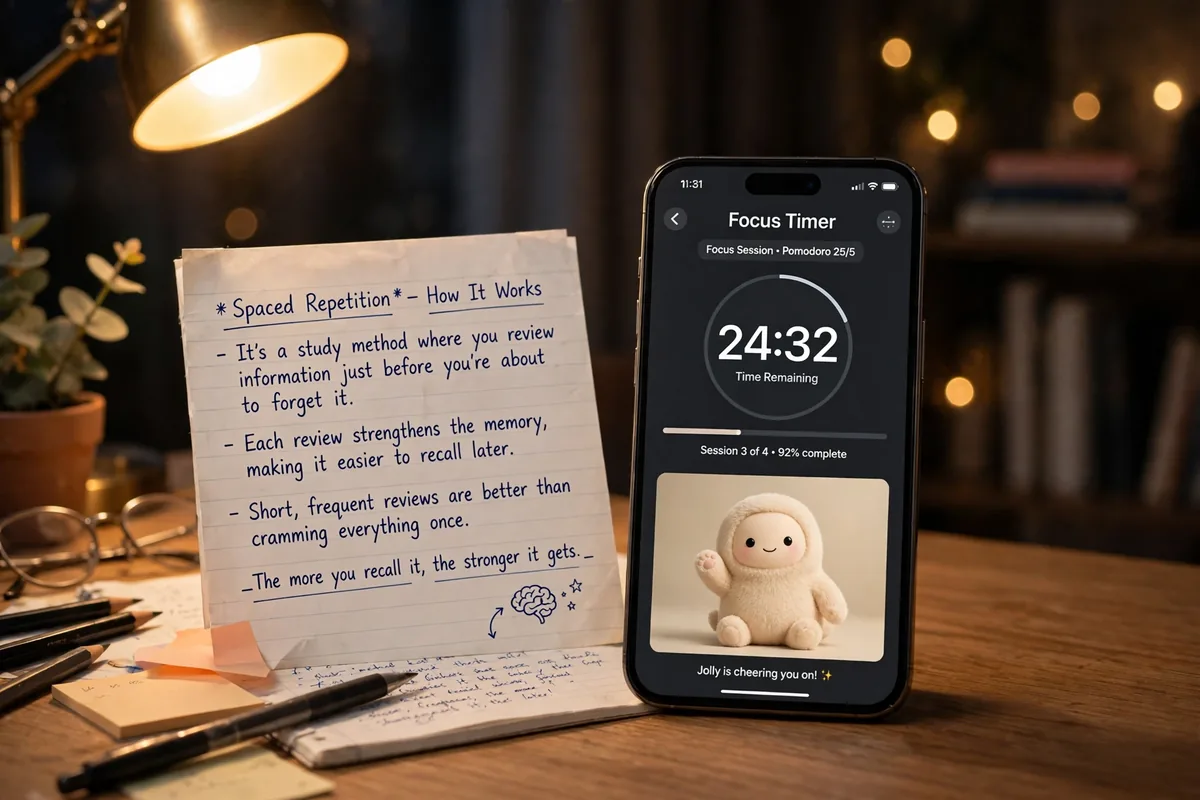
One concept usually takes 20 to 30 honest minutes. A few explaining. Ten or so hunting gaps with the book. Then a clean re-explanation. Convenient, that. It means one concept fits one focus session. Small concepts take less. Past 40 minutes, though, the concept was too big. Split it, then. Second half gets its own session tomorrow. Depth on one small thing beats a shallow lap of a whole chapter. Every time. Every single time.
Can you use the Feynman Technique for maths and science?
Yes. Best there, arguably. Maths and science explanations have joins that either hold or visibly snap. With maths, your explanation is not the worked answer. It is the why behind each step, said in plain words. If you cannot say why you are dividing both sides, the gap is found. And it was never really an arithmetic gap. For memorisation heavy subjects it still works. Pair it with self testing and spacing, though. Explaining builds the understanding. The testing is what makes the facts stay put for exam day. And for facts that must come out in a strict order, lists, sequences, steps of a process, the storage tool built for the job is the memory palace.
Want a timer keeping those 25 minutes honest? Try Fluffy Friend, free on Google Play, with its study timer mode, flexible lengths for the days a concept needs longer, and a pet celebrating your finished sessions. Every in-app purchase supports real animal shelters. Tonight, then. One concept. The wall gets the explanation. The wobble tells you what to study next. It usually is.