Interleaving: Why Mixed Practice Beats Blocked Practice

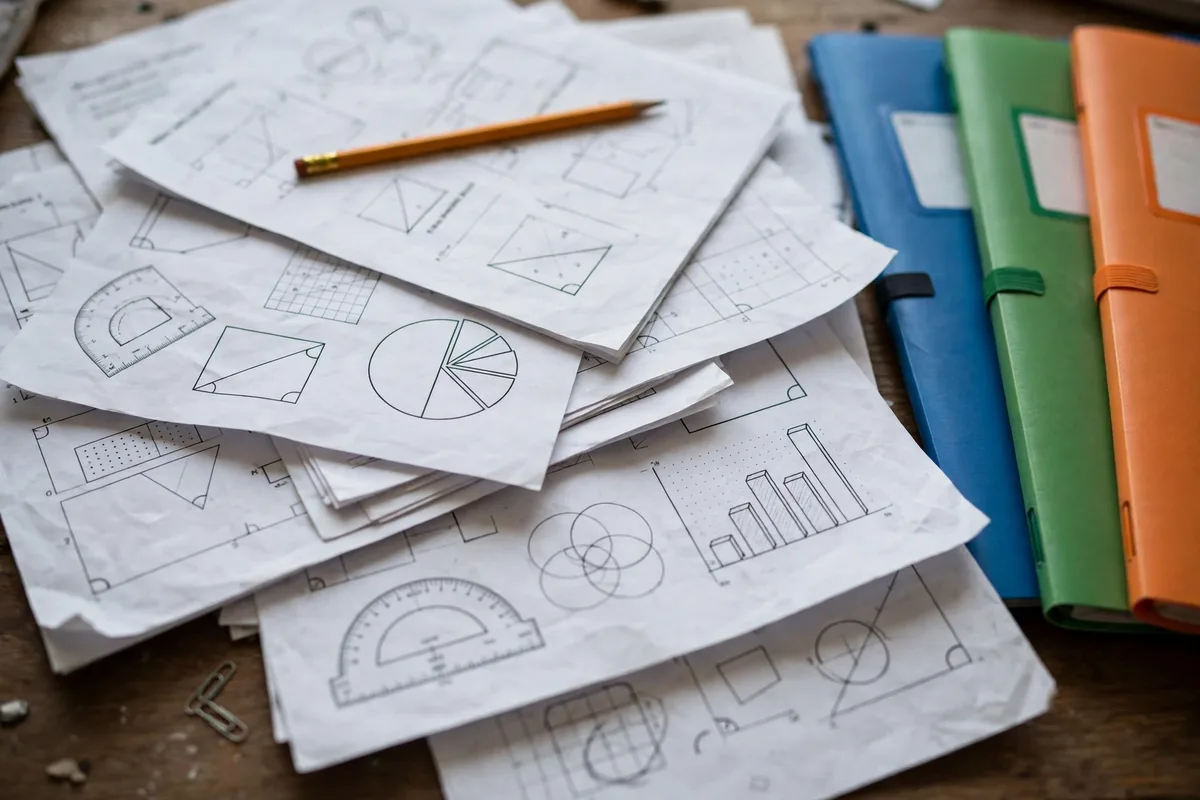
Maths problems on the desk. Two ways to work through them. Way one: all the type A problems. Then all the Bs. Then all the Cs. Neat blocks. One kind at a time. Page after page, same move, over and over. Way two is ruder: shuffle the pile. Take them as they come. A, C, B, A, B, C, no idea what the next one is until you read it. Nearly every student on earth practises way one. Nearly every study on the question says way two wins. Not narrowly, either.
The shuffle has a name. Interleaving. And it comes with a catch, the catch that puts people off it for years: it feels terrible. Mistakes everywhere. Slower. You walk away certain the session went badly, because by every feeling you have, it did. The blocked session feels great. You fly. Then exam day comes. Exams shuffle their questions, always have, and the result flips clean upside down. What follows: the evidence, why the mixing works, how to run a mixed session inside an ordinary study block, and the one situation where you should leave the pile unshuffled.
Blocked, interleaved, and the practice session lie
Definitions first. The words matter here, so. Blocked practice means you finish one type completely. Only then do you start the next. AAABBBCCC. Interleaved practice, you mix them as you go. ABCABCABC, or a true shuffle, better still. Same problems. Same total time. Same student. The only difference is the order.
Here is the lie. During practice, blocked wins. In the first proper study of this, students doing blocked maths practice solved their problems smoothly and accurately, because once you have done three type A problems in a row, the fourth one needs no thought about method at all. You are repeating a motion, that is all. Interleaved practice is ruder. It forces a decision before every single problem. What kind is this one. And what does this kind need. That decision is effortful, error-prone, and it feels like struggling. Students reliably judge blocked practice as the method that is working. Students are reliably wrong, and the exam is where they find out.
What the studies keep finding
The study that started it is Rohrer and Taylor, 2007, on students learning to calculate the volumes of different solid shapes. In practice, the blocked group looked far better. On a test one week later, the picture reversed hard: the interleaved group scored about 63 percent, the blocked group about 20. Read those numbers again, because they are the whole post in miniature. The method that felt worse produced roughly triple the score a week later, when it mattered.
Then it left the lab. Taylor and Rohrer, in 2010, ran it with fourth graders practising four kinds of maths problems. Tested a day later, the interleaved children scored 77 percent against 38 for the blocked group. And the errors told the story: the blocked group's mistakes were mostly discrimination errors, using the wrong method for the problem in front of them, at a rate of 46 percent, against 10 percent for the interleaved group. The blocked children could do every method. They just could not tell which one a new problem wanted.
The biggest test came in 2020, when Rohrer and colleagues ran a randomised trial across 54 classes in five schools, 787 students, four months of ordinary maths assignments, then an unannounced test a month after that. Interleaved practice won again, 61 percent to 38. Not a lab trick, not a one-off: a whole school term, real homework, a test nobody crammed for.
It is not only maths, either. Kornell and Bjork, in 2008, had students learn to recognise the painting styles of different artists, a pure judgement task with no formulas at all. Interleaving the artists beat studying them one at a time, and here is the detail we love most: the students themselves believed blocking had worked better for them. Their judgement of their own learning was not just wrong, it was backwards.
Worth knowing the idea did not even start with schoolwork. It showed up first somewhere else entirely: motor learning research, late 1970s. Athletes who practised several skills in a mixed order learned them better than athletes drilling one skill at a time. Sports coaching has quietly run on mixed practice ever since. The classroom studies are really the education world catching up with the gym.
Why mixing works when blocking does not
An exam never labels its questions. Nobody prints "this is a type B problem" above question four. So every exam question is secretly two questions. Which method does this need. Then, can you run it. Blocked practice only ever trains the second one. After the first problem in a block, the method is already chosen, by the block, not by you. You get fluent at running methods and stay hopeless at choosing them, and choosing is the skill the exam tests first.
Interleaving trains the choosing on every single problem. Every switch makes you stop. Look at a fresh problem. Work out what it even is. Then drag the right method out of your own head. Nobody in the room hands it to you. That dragging has a name, retrieval. Same engine that powers active recall. The effort is not a side effect of the learning. The effort is the learning. And there is a bonus hiding in it. Each type keeps coming back after gaps, so half the benefit of spaced repetition rides along free. You scheduled nothing.
Read the uncomfortable feeling as information, then. Because that is what it is. Smooth session? You rehearsed motions, most likely. And a session that feels like small fresh problem after small fresh problem, that is learning, felt from the inside. Researchers call difficulties like this desirable. Students call them annoying, which, fair enough. Both are right, annoyingly.
How to interleave a real study session
The good news is that interleaving needs no new materials, no new app, no new system. It needs a shuffle. Here is how we would run it inside one 25 minute focus block.
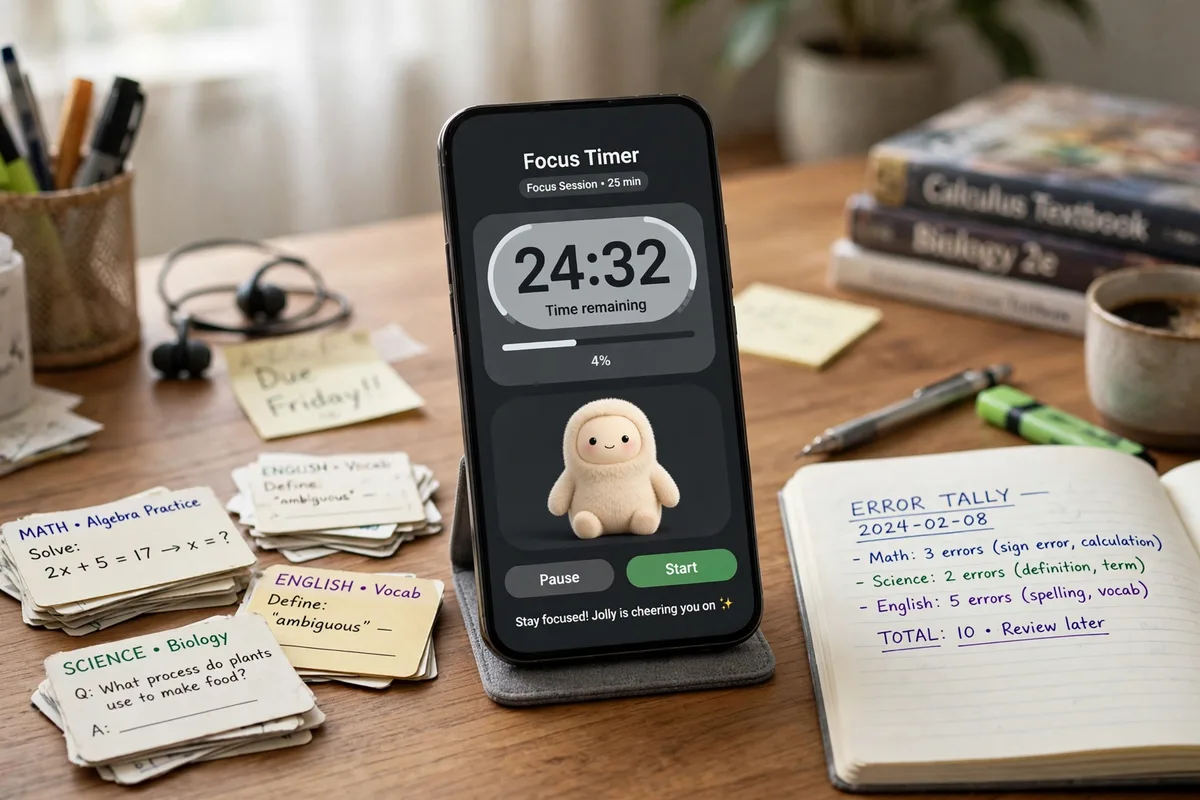
Start with three topics. Ones you have already learned, roughly a third of the set from each. On paper? Shuffle the pages with your actual hands, properly, until you honestly cannot guess what is coming next. Then work the pile in order. Before you touch a problem, say what type it is. Out loud, ideally, in your head if the room is full. Say why, too. That naming step is not garnish. It is the entire rep you are training. Cannot name it? Write that down, that goes in the notebook, it might be the most useful finding of the whole session. Check answers in small runs. Three problems, four, then check. Not at the very end, when it has all gone cold and useless. A wrong method caught while the problem is still warm teaches something. And keep an error tally, two columns in the margin. Column one, ran the method wrong. Column two, chose the wrong method. Column two is the one this whole method exists to shrink, and watching it shrink over a fortnight is satisfying in a way blocked practice never once offers.
It travels, too, beyond maths, with a bit of translation. Science: mix the question types. A calculation. Then a define-and-explain. Then a graph question. Round again. Languages: stop drilling one vocab theme to death, shuffle across themes, and throw grammar items from earlier weeks into the pile where they do not belong. Essay subjects: rotate the planning practice. Argue a case. Compare two views. Evaluate a claim. Because the choosing skill there is reading a question and knowing what shape of answer it is asking for. The rule underneath all of it is simple. Where the test hands you unlabelled items and makes you pick the approach yourself, a mixed set rehearses the real thing. A blocked set rehearses a test nobody will ever set you.
Across a whole week the same pattern scales up, too. A topic you learned on Monday joins the mixed sets on Wednesday and Friday, alongside the others, instead of getting its own private day and then retiring. That rotation is why our exam plan in how to study for exams builds mixed review blocks into the last stretch before a test. Exams are mixed. Practice that matches the shape of the test leaves fewer surprises in the room on the day.
One honest warning about session feel. Your accuracy in mixed practice will drop. Maybe a lot. Blocked sessions had you at 90 percent; the shuffle might put you at 60, and every instinct you own will say the shuffle is broken, go back to blocks. That instinct is the illusion. It is the exact one the studies keep catching, in study after study, decade after decade. So judge the method properly: a delayed test. Self-test a few days later, cold. Never judge it by how the practice session felt, the feeling is the one witness here who always lies. Practice performance and learning are different things. Most topics let you pretend otherwise. This one does not.
When not to interleave
There is one clear exception, and skipping it ruins the method for a lot of people. Brand-new material gets a blocked first pass. Met a problem type twenty minutes ago? Can barely run its method with the book open in front of you? Shuffling that in with two other types buys you nothing. Not desirable difficulty. Mush. So learn each type on its own first. Short block. A handful of goes, until you can do two or three unaided without the book rescuing you. Then it graduates. Into the mixed pile it goes, and there it stays.
The night before an exam is a softer version of the same point. Mixed review then is fine and probably ideal, since the exam is hours away and choosing is the skill being tested. But it is not the night to meet a brand-new topic and interleave it heroically. New goes blocked or does not go at all. That is the job interleaving does: consolidation. It sharpens work you have genuinely started. Feed it started things, not strangers.
Interleaving: questions students actually ask
What is interleaving in studying?
Mixing. That is genuinely the whole of it. Problem types, topics, shuffled together inside one session. No finishing type A completely before type B is allowed to appear. Blocked practice goes AAABBBCCC. Interleaved practice shuffles to something like ABCABCABC. The problems and the total time are the same. Only the order changes. And the order, it turns out, was the whole game.
Why does interleaving feel harder than blocked practice?
Because it is, in fact, harder. Harder in the way that counts, yes, but let us not dress it up: harder. In a block, choosing never happens. The block chose the method at problem one and every problem after is repetition wearing a practice costume. A mixed set asks it every time. What kind is this one. What does it need. That identifying step takes effort. It goes wrong, often, in practice. And it is precisely the step the exam will test you on. The struggle is not a side effect. It is the training.
How do I interleave practice in a real session?
Three topics, already learned. Shuffle the problems until the order looks daft. Work through them in that order regardless. Name each type before solving, out loud if you can stand it. Check answers in small batches. Tally the mistakes in two columns, method errors, choosing errors. Then judge the whole experiment by a test days later. Never by how the session felt, the session will feel awful and that is the point.
When should you not interleave?
When the material is brand new. A problem type you have only just met needs a short blocked first pass, until you can run its method unaided a few times. After that, into the mixed pile, permanently. Interleaving sharpens what you have started. As a first-meeting tool it is hopeless, honestly.
Is interleaving the same as spaced repetition?
No. Cousins, yes. They stack well. They are not the same thing. Spaced repetition answers a when question. Same material, spread over days, no cramming it into one sitting. Interleaving answers an order question. What sits next to what, inside one session. Mixed types, no blocks. Run a mixed set today, again Thursday, again next week, and you have both at once. Which is about the strongest practice structure the research currently has to offer anybody.
Revision currently running in neat blocks? The experiment costs nothing but a shuffle. Next three topics you study, mix one practice set out of them. Then wait. Self-test a few days later, cold, and read the number off that. Not the feeling from the session. The number. Run the mixed sets inside timed sessions, it helps the habit stick: Fluffy Friend, free on Google Play, keeps a session history that has your topics rotating instead of quietly retiring. Every in-app purchase supports real animal shelters. So, shuffle the pile, and when it feels worse than the neat blocks did, trust the delay anyway.