Sleep and Memory: Why Sleep Beats an All-Nighter
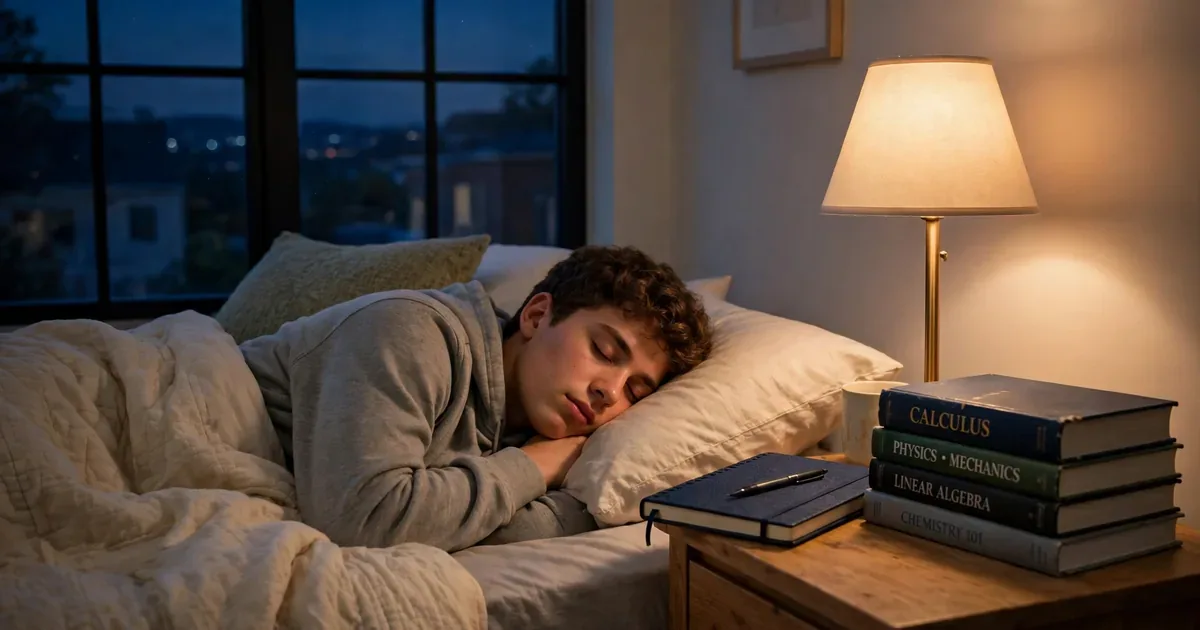
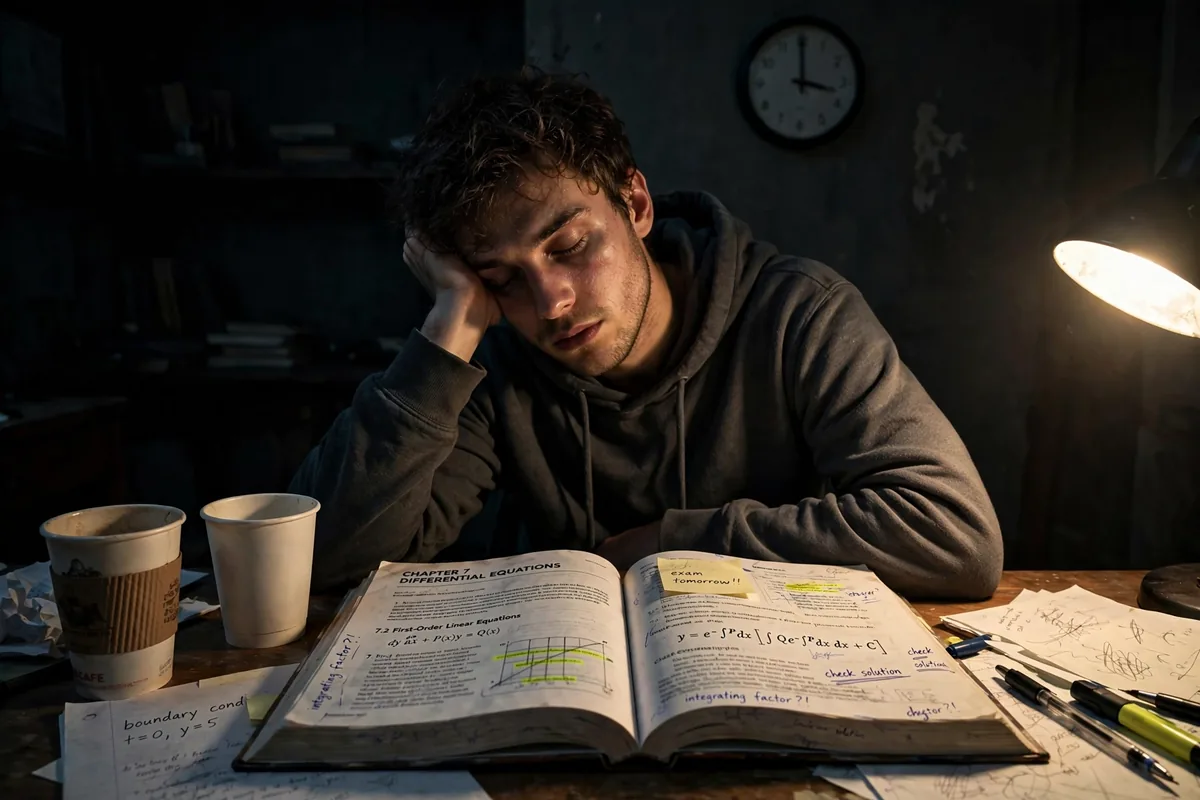
It is 11 pm, the exam is at 9 in the morning, and you have covered, generously, about half the syllabus, the half you covered being last week's work, which by now might as well be last year's. There are two doors in front of you and both look bad. Door one: keep going, coffee, desk lamp, the whole night, and walk in having technically seen everything. Door two is the book closing. Sleep. Walk in tomorrow having seen half of it, like a person who has given up. Almost every student picks door one. It feels like fighting. Door two feels like surrender, even when it is not.
Here is the thing nobody tells you in the corridor. Door two is not surrender. For a memory exam, door two is usually the better bet by a distance, because sleep is not the absence of studying at all, it is the second half of it, the half where the learning actually gets kept. The all-nighter does not just fail to help. It spends the night deleting the value of the work you already did, and then sends you into the exam in a state you would not legally drive in. We make a study timer app, so our whole job is the hours at the desk; this post is about the hours off it, which do more for your grades than the last three hours of any cram session.
What sleep actually does to a day of studying
When you learn something during the day, the memory of it is fragile, stored in a temporary way, easy to overwrite, easy to lose. The leading account of what happens next, the one Diekelmann and Born reviewed in Nature Reviews Neuroscience in 2010, says sleep is when the brain replays the day's new memories and gradually shifts them into longer term storage. The replay mostly happens in deep slow wave sleep. That is the heavy, dreamless kind, early in the night. Later comes REM sleep, the dreaming kind, and its job seems to be different again, more about knitting new material into what you already know, the creative connect-the-dots side of a subject.
One sentence version, the only one a student really needs: studying writes the draft. Sleep saves the file. Skip the sleep and the document is unsaved. Some of it survives anyway, the brain is not a laptop, but a meaningful share of the day's learning never gets consolidated, and no amount of rereading at 4 am replaces the process, because the process is not reading. It is something the sleeping brain does offline, on its own schedule, in cycles of roughly ninety minutes.
This is also why the night after learning matters more than the night before the test. Both matter. A student who studies across the week and sleeps after each day arrives at exam eve with the material saved in layers. The all-nighter is an attempt to do a week of saving in a single night of writing. The machine does not work that way. It never has.
The part nobody expects: sleep before learning matters more
The familiar story is sleep after studying, consolidation, fine. What surprises people is that sleep loss before learning does even more damage than sleep loss after it.
Back in 2007 there was a brain imaging study, Yoo, Hu and Walker, in Nature Neuroscience. One group slept normally. The other group was kept awake all night. Then both tried to learn new material inside a scanner. The scans showed the sleep deprived group's hippocampus working at a fraction of normal. The hippocampus is the inbox for new memories, remember. With the inbox half shut, they remembered less of what they tried to learn. The authors put it without softening: sleep before learning is critical, they wrote, for preparing the brain for next day memory formation. A tired brain does not just save badly, it takes in badly, the inbox half shut.
A 2021 meta-analysis helps here, Newbury and colleagues in Psychological Bulletin, dozens of studies pooled. Before learning, deprivation impaired later memory at an effect size of about 0.62, medium to large in researcher language. After learning, the consolidation direction, it came in at about 0.28. Still real. Still worth avoiding. About half the size. Read that again before your next exam eve: the night of sleep you are thinking of trading away protects tomorrow's ability to learn at all, and that protection is worth more than the saving step everyone talks about.
What the all-nighter evidence actually says
Fine. Sleep is good. Everyone knows sleep is good. But does one all-nighter really hurt grades? Here is the evidence.
Thacher, in a 2008 study in Behavioral Sleep Medicine, found that around 60 percent of the students surveyed had pulled at least one all-nighter since starting college, and that habitual all-nighter students had lower GPAs. It is a correlation, we will say so out loud: students who cram all night may differ in other ways. But the direction matches the lab work, and nobody has found the study where the all-nighter crowd wins.
Then there is the cruellest finding in the area. Pilcher and Walters, 1997: students kept awake for 24 hours did significantly worse on a critical thinking test than students who slept about eight hours, and here is the knife, the sleep deprived students rated their own concentration, effort and performance higher than the rested group rated theirs. Sleep deprivation impairs your ability to notice you are impaired. The 3 am feeling of I am flying, it is all going in, is a symptom, not a report.
There is a mechanism for that false confidence. Gujar and colleagues at UC Berkeley reported in 2011 that a sleepless night turns up the brain's reward circuitry and turns down the prefrontal regions that normally keep optimism honest, producing a kind of wired euphoria. It feels like momentum. It is chemistry. Decisions made in that state should be treated the way you would treat decisions made by a cheerful drunk.
And that comparison, drunk, is not just a metaphor we are enjoying. Around 18 hours awake degrades reaction time, working memory and judgement to roughly the level of 0.05 percent blood alcohol. Past 24 hours, you are around 0.10, over the legal driving limit in most countries. Nobody would sit an exam after four drinks. And yet students sit exams in that state every term and call it dedication.
The exam eve protocol: what to actually do tonight
Advice that ends at sleep more is useless at 11 pm with half a syllabus, so here is the protocol, hour by hour, for the night before. It assumes a 9 am exam and that you are behind, because that is the situation it exists for. If the nerves themselves are half the problem, our post on test anxiety covers the routines for the week before, the night before, and the first two minutes in the chair.
By about 9 pm, stop taking in new material. Nine is not magic, it is just that new material learned after that point has the least time to be consolidated and the highest chance of being the fragile kind, so the last study block of the night should be a recall block, book shut, where you write down or say back everything you can on the topics most likely to be examined. This is the highest value hour of the whole evening. Wondering how that recall block should look in practice? Our post on how to study for exams lays out the full final week, and the spacing logic underneath it is the same one in our spaced repetition post.
Now set a lights out time. It has to protect six hours at least. Seven to nine is the real target where the syllabus allows it. Six hours is roughly four full cycles, which means waking at a boundary instead of being dragged out of deep sleep, and it keeps a decent share of both the early slow wave sleep and the later REM. Then stop negotiating, because the negotiation is where the night goes.
Caffeine needs cutting off at least six hours before you plan to sleep, earlier if you can manage it, because even caffeine taken six hours before bed has been shown to measurably eat into the night's sleep, and the cruel part is that you may fall asleep fine and still lose the deep portion, which makes the 4 pm coffee a loan taken against the exam.
Morning. Normal wake up time, or a touch earlier. Not dramatically earlier, that way lies madness. Spend fifteen minutes on one more recall pass, the same topics, book shut, checking what the night kept. Students are often startled by how much of the evening's list is suddenly just there, solid, in a way it was not at midnight. That is consolidation, felt from the inside. Then eat, and go.
Naps: the legal cheat code, with rules
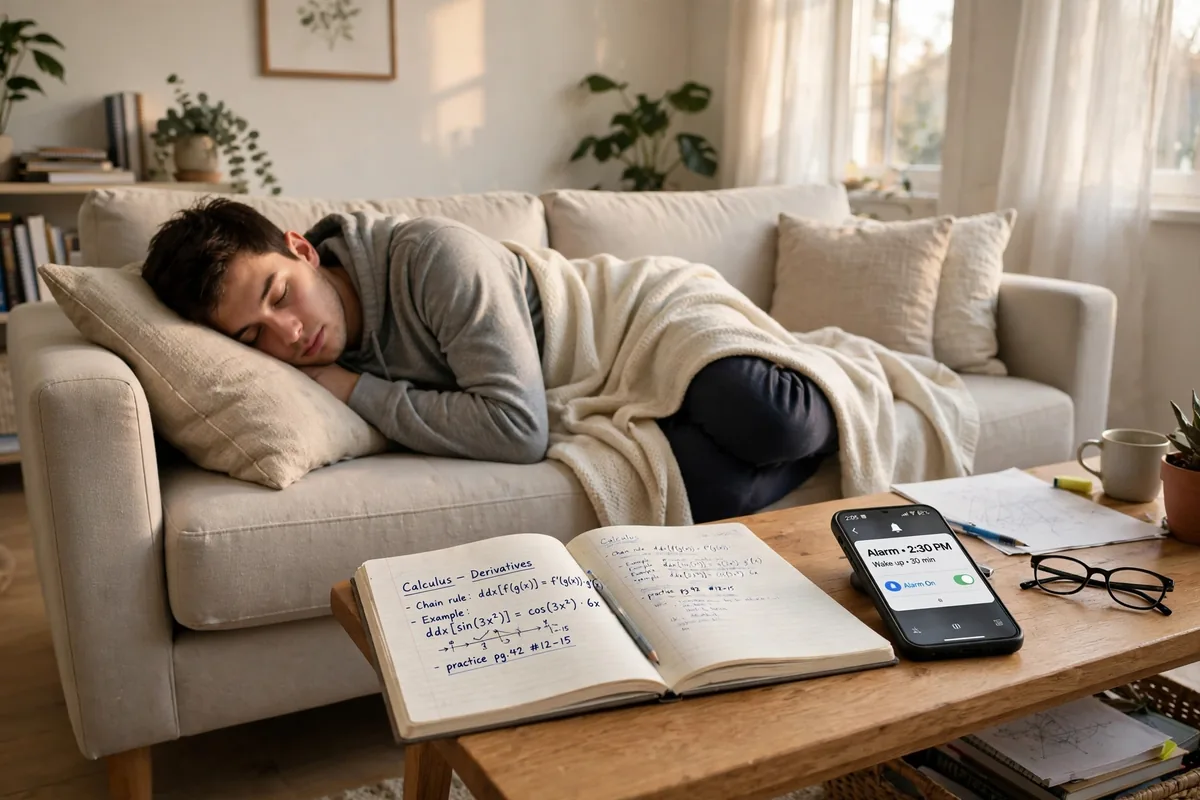
A nap buys you a small slice of consolidation inside a study day. That is the good news. The catch: naps have rules, and a nap done wrong leaves you worse off than skipping the nap entirely.
Short is the rule. Twenty minutes, alarm set, no negotiating with the alarm either. That keeps you in light sleep, so you wake up clear headed. Push towards an hour and you slide down into deep sleep, and waking from deep sleep brings sleep inertia with it, twenty groggy minutes of being technically awake and functionally furniture. Got a full ninety minutes free? Then a whole cycle works too, because you surface at a boundary.
The slot is early afternoon, not 6 pm, because a late nap spends the tiredness you were saving for the night, and then the night sleep itself, the one doing the heavy consolidation, shows up late and shallow. A nap after a study block beats a nap before one, too, because the brain gets fresh material to replay. Students who cannot start at all are usually not facing a nap problem, that is a starting problem, and our study motivation post covers the first five minutes of it.
The one case where the all-nighter is the least bad option
Honesty section. There is a case, and pretending otherwise would make the rest of this post a lecture. Coursework is the exception. An essay, a problem set, anything marked on the work itself rather than on what you remember: staying up to finish that can be the rational trade. You are selling consolidation you may not need to buy a deliverable you definitely need. Fine, do it knowingly.
What is never a good trade is the all-nighter before a test of memory and thinking, which is most exams. There, the night sells the exact faculty the morning is examining. Students who learn this stop asking whether all-nighters work, as if it were one question. It is two. For producing work, sometimes. For remembering work, nearly never, and the evidence above is what nearly never rests on.
Sleep and memory questions students actually ask
Is it better to sleep or study the night before an exam?
Sleep, for almost every exam, and it is not close. Sleep, because sleep is when the day's studying gets consolidated into memory you can actually use. A sleepless night also wrecks your judgement, your ability to tell a good answer from a bad one, which is more or less what the exam is testing. So study hard until the evening. Finish with a recall session, book shut. Then protect six hours of sleep at minimum, ideally more. The 3 am rereading buys familiarity that mostly evaporates. The sleep buys keeping the work you already did.
How much sleep do you need before an exam?
Aim for the same 7 to 9 hours you would want on any night, because the last part of the night is rich in REM sleep and cutting the night short cuts REM first, although if the situation is genuinely bad, six hours is the floor we would defend, on the grounds that it keeps roughly four full sleep cycles and both kinds of sleep in decent proportion. Below that the returns collapse fast, and below four hours you are sitting the exam in a measurably impaired state and, worse, you will probably feel fine about it, which the Pilcher and Walters study says is part of the impairment.
Do all-nighters ever work?
For finishing work that is due, sometimes, yes. You trade tomorrow's memory and alertness for a submission, and occasionally that trade is worth it. For learning or remembering, no. The evidence is not kind: all-nighter students tend to have lower grades, and sleep deprived students learn new material measurably worse the next day. And that wired, confident 4 am feeling? A chemical side effect. Not a sign it is working. If all-nighters worked, the students who pulled them would top the class, and nobody has ever found that study.
Does a nap help you remember what you studied?
Yes, short and early. A twenty minute nap soon after a study session opens a small consolidation window without dropping you into deep sleep, so you wake clear and the material sets better than it would if you had just pushed on tired. Aim it at the early afternoon. The trap is long late naps: an hour down in deep sleep leaves you groggy, and a 6 pm nap steals the tiredness your night sleep was counting on. Top-up, never replacement.
When should you stop drinking coffee before an exam day?
Stop at least six hours before you plan to sleep. Earlier is better, honestly. Caffeine has a long tail: a meaningful share of the coffee you drink at 4 pm is still in your system at 10 pm, and research has found that caffeine even six hours before bed can cut into the night's sleep by around an hour's worth, often without you noticing, because you fall asleep but sleep lighter. On exam eve that lighter sleep is exactly the deep sleep your memory was counting on. Front load coffee to the morning, then let the evening be boring.
None of this needs a sleep monk. It needs the desk hours and the pillow hours to stop being enemies. Run the sessions properly, timed, finished at a sane hour, and sleep stops being the thing you sacrifice and starts being the thing that cashes the sessions in. Fluffy Friend is free on Google Play if you want the desk half handled, timed focus sessions, a history that shows when you actually stopped each night, and streaks for the days you ran it properly. Every in-app purchase supports real animal shelters. Study like it matters, then go to bed like that matters too. It is the same process, and the second half happens with your eyes shut.