Study Motivation: How to Start When You Don't Feel Like It

You know the position. Book on the desk, still closed. Phone in your hand, somehow. You have told yourself "five more minutes" four times now, and the five minutes keep winning. And you think, honestly, why do I have no motivation to study, again? What is wrong with me?
Probably nothing is wrong with you. Study motivation, for most people most days, does not arrive before the work starts. It turns up partway into the work, late, like a friend who said they were on their way an hour ago. If you have lost motivation to study, or your study motivation just goes quiet every evening around homework time, the fix is rarely a better pep talk. It is a smaller start.
We make a study timer app, so we hear this complaint constantly. I do not feel like it. Fine. Neither do we, some days. This post is about what works on those days: why the feeling runs late, a script for the first five minutes, and day two.
Why study motivation feels broken (and why it is probably not you)
Most study motivation tips start from the same quiet assumption. First you get motivated, then you open the book. Feeling first, action second. It is also, mostly, backwards. Study motivation is usually the result of studying, not the entry fee.
Therapists figured this out a while ago. There is a treatment built on this, behavioural activation, made for people whose motivation has gone properly dark. The deal: act first, on a schedule, feel like it or not, and let motivation trail in after like a dog. Jacobson and colleagues took that therapy apart in 1996, and found the doing piece, alone, matched the whole package. The doing was the engine.
Now, you are probably not depressed, just a student with a chapter to read. Different dose, same direction. Wait to feel like studying and you can wait all evening. Start, badly, for a few minutes, and something in your head goes, oh, we are doing this then. The feeling catches up. Not always, not magically. Often enough to bet on, anyway.
Framing the whole thing as willpower, by the way, helps nobody either. If starting hangs on a feeling that only turns up once you have started, failing to start is hardly a character flaw: sequencing error, that is the whole of it. And momentum, that is no personality trait either, it is the first few minutes, felt from inside.
Motivation to study runs late: blame the delay
Piers Steel could not resist a formula for it, Temporal Motivation Theory (2007), and the formula says motivation is, roughly, confidence times value, over impulsiveness times delay till payoff. That is study motivation in one ugly little equation.
Delay is the killer in it. Exam in six weeks? The delay there is enormous, so motivation sits near zero, whatever the grade is worth. Exam tomorrow morning, though? Delay is tiny. And suddenly you are a studying machine, running on panic and instant noodles, pulling off in one night what six calm weeks could never get out of you. Same brain. Same subject. Different delay. Panic is doing some of that last-minute work, of course. What it costs you in the exam itself, and how to calm it, is covered in our post on test anxiety.
So the classic question, how to motivate yourself to study when the exam is miles away, gets an answer nobody much likes. You mostly cannot argue with the arithmetic. Cheating the arithmetic is allowed, though, and the cheat is shrinking the delay. Finish lines close to you, one short session, one reward straight after, tonight, not in six weeks. And raise the confidence part, with smaller units you can actually finish. Push the impulsiveness part down by putting the distractions physically further away. We went deeper on this in our post on beating procrastination in your first week of focus, because procrastination is this same equation in a different hat.
The first five minutes: a starter script for zero motivation days
All the guides on how to study when you don't feel like it say start small. True, start small, and useless at 7 pm all the same, when you are staring at a textbook, because small is a size, it is not a plan. So here is a plan instead. How to start studying when you don't want to, at all, comes down to these five minutes. Run them like a script. A script means no decisions, and decisions are where the evening goes to die.
Minute 0 to 1 is standing up and clearing one patch of desk, about the size of the book. Put the book on the patch. Phone goes in another room, or face down on the far side of this one. Sit down. That is the first minute. It counts.
Minute 1 to 2: pick the smallest unit you can see the end of. One page. One problem. Five flashcards. Not chapter four, not "biology". A unit with an edge. If everything looks huge, open the book anywhere and take that page. Random is fine. One page of Cornell notes counts as a unit too, and it arrives with its own little test built in.
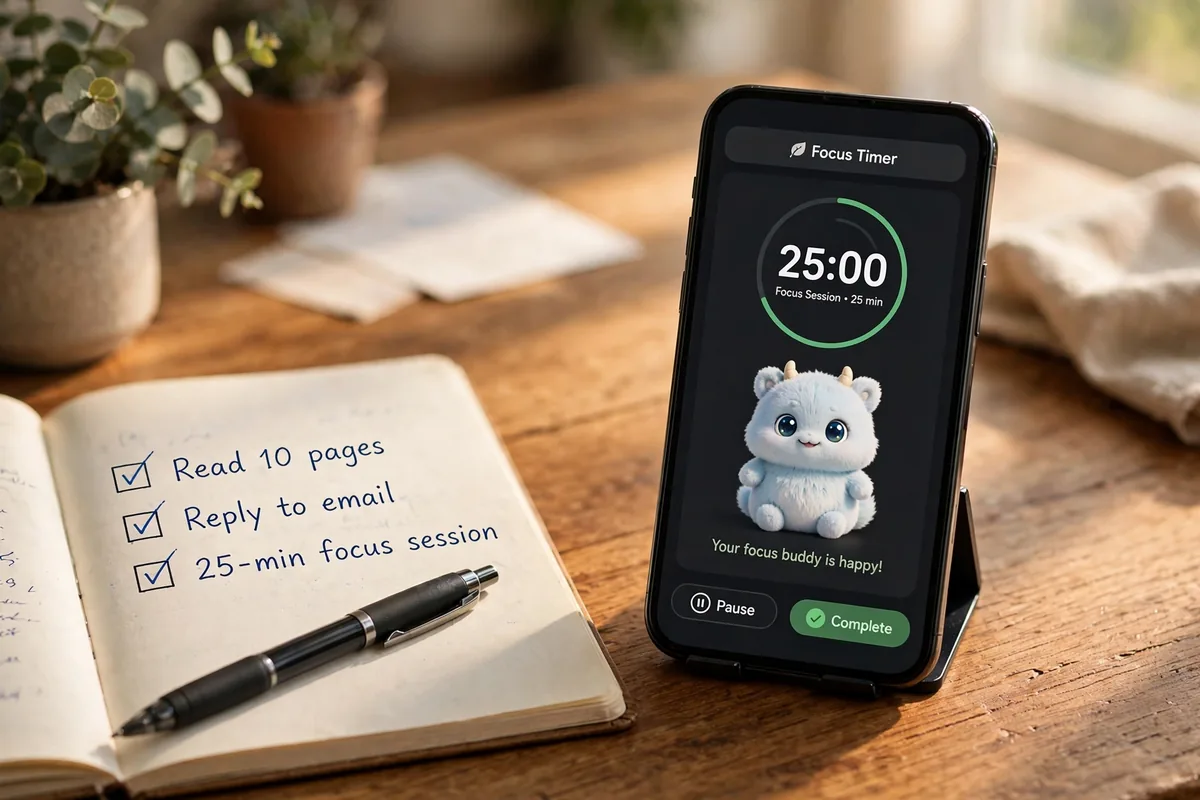
Minute 2: start a timer for 25 minutes. In our app that is one focus session, and the pet on screen watches you do it, but a kitchen timer does the same job. The timer makes the deal concrete. You are not studying until you feel better. You are studying until it rings.
Minutes 2 to 5: work the unit. Badly, if badly is what you have. Skim it. Guess at the answers. Underline whatever sentence makes no sense. You are not really learning yet. Learning is minute 10's problem. You are starting, which was the whole job.
Minute 5: you get a genuine choice. Stop, if you want, with no guilt attached. You started. That was the assignment. Or keep going, because most days the resistance has gone weirdly quiet by now. No study motivation required for any of it, which is lucky, because there was not going to be any. The only losing move was the one where the book never opened at all.
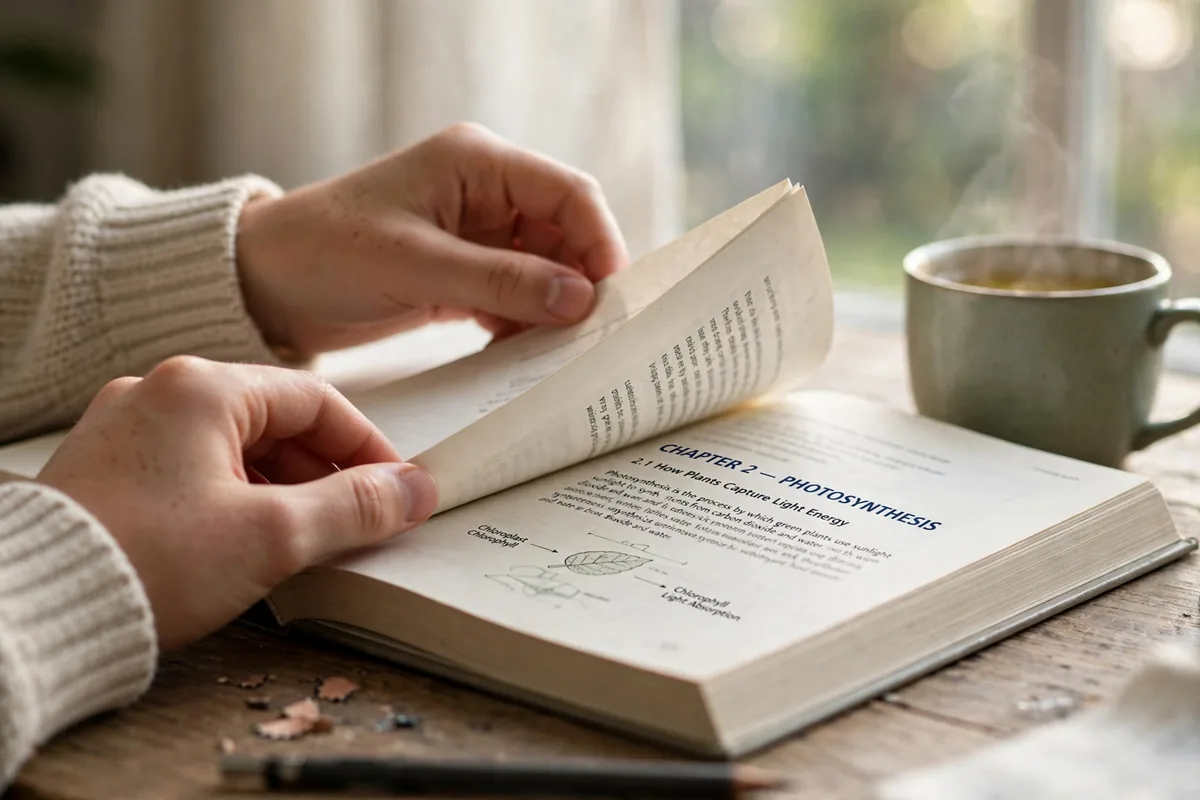
Look at what the script is actually built out of. Furniture, paper, and a timer. No feelings required. Feelings are weather; furniture stays put.
Leave a loop open and your brain keeps pulling you back
In 1927 a psychologist named Bluma Zeigarnik noticed waiters remembering a complicated order perfectly until the bill was paid, and after that, nothing, gone. She tested the idea, and people remembered interrupted tasks far better than finished ones, roughly twice as well, in her experiments. Started things stay live in the mind, finished things get filed.
That is the Zeigarnik effect, and it is quietly the reason minute 5 works. Once you have started, the task has a hook in you. It nags, politely. Coming back to a started thing feels nothing like a cold start.
So use it on purpose. When a session ends, stop mid page sometimes. Mid problem. Leave the next question already read once. Tomorrow you are not starting, you are resuming, and resuming is ten times easier, study motivation does love a head start. One warning though, keep open loops to one or two, because past that the pull stops and it is just noise. A loop nagging at the wrong time gets its next step written down. Masicampo and Baumeister, in 2011, found the thoughts about an unfinished goal stop intruding once a plan for it exists on paper. The loop waits, quietly, once it trusts a plan exists on paper. More or less, anyway.
Pair the boring pages with something you actually enjoy
If the start is the wall, rewards are the door in it. There is a neat trick called temptation bundling, from a 2014 study by Milkman, Minson and Volpp. They gave gym members audiobooks they genuinely wanted to hear, but the catch was the books only lived at the gym. Gym visits in that group rose 51 percent against the control group early on. The wanting pulled the should along behind it.
The study version writes itself, because study motivation can be smuggled in through a want. The good coffee is only for study sessions. The playlist you love only plays during revision. The nice cafe is your study spot and nothing else's. The want has to ride along with the should, at the same time, not dangle afterwards as a prize you will skip.
One honest caveat, because the study has one. The effect faded over the nine weeks, especially after a holiday snapped the pairing. That is not the trick failing. Pairings just do that. After any break the pairing needs redoing, deliberately. Expect it beforehand and it stops feeling like proof nothing works on you.
Rewards over punishment is basically the design brief of our whole app: coins for sessions, a pet that celebrates your finishes. Guilt as a running fuel is a mistake all its own: fast burn, and it stinks as it goes. Pair a small want honestly with the work and it tends to outlast the guilt.
Decide before the mood arrives: if-then plans, little choices
The script works even better when you do not have to invent it in the moment. Peter Gollwitzer studied implementation intentions back in 1999, a grand name for a one-line plan: if this situation comes up, then this action. If it is half past six and I am sat at the kitchen table, then I open the book at the bookmark. Give your goal a when and a where, Gollwitzer's students did, and follow-through rose noticeably; Sheeran's 2002 meta-analysis found that held across study after study.
Tonight, then, one line on paper: tomorrow, this time, this chair, this book, this page. Tomorrow-you does not need motivation then. Tomorrow-you just needs to read a note. Easier job by a mile.
The other half of this is quieter. Deci and Ryan, the self-determination theory pair, found motivation holds up when three things get fed: choice, capability, connection to people. Practical version. You pick the subject order and the units, units you can finish, so the capable feeling gets evidence. And you study alongside someone sometimes, a friend, a study group, even just a leaderboard of humans on the same chapter. Choice, wins, company. Starve the three and punishment is what even a liked subject starts to feel like. One-off sessions hardening into a real study routine works that way too, the way building a habit that actually sticks makes effort the default setting.
Day two, when it still feels just as bad
Right. Day two. You ran the script yesterday, it worked, sort of, and today your study motivation feels exactly as flat as before all of this, and nobody ever warns you about day two, though plainly it is normal and yesterday has not failed because of it.
Day two protocol is boring on purpose. Same time as yesterday again, because routines are built out of sheer same-ness. Same script again, all five minutes, no upgrades. If resistance feels heavier today, then the unit shrinks again. Half a page is a legal unit. Three flashcards is a legal unit. The session still counts, the study streak still counts, and a run of days is evidence your brain believes. Miss a day and skip the punishment maths of owing double tomorrow. Double tomorrow and your brain learns studying means suffering. Just restart small. Our post on habit streaks and how to save a broken one lays out how.
Genuinely rough day? The session shortens as well. The 25 minute block is only a default, never a law, and it drops to 15, even 10, with the timer still boss. That flexibility is the whole point of our Pomodoro for ADHD routine, and it works for anyone having a bad week, diagnosis or not. Study habits are not built on your best days. They are built on the days you did the small version instead of the nothing version.
Study motivation questions students actually ask
How can I motivate myself to study when I do not feel like it?
Mostly you cannot, is the short version, and happily there is no need to. Run the five minute script. Sit down. Clear the patch. Pick your one tiny unit, get the timer on, work it badly if badly is what it takes. The feeling you wanted usually shows up minutes into the session, because the session is where it lives. Wait for it before you start and the waiting will eat the whole evening.
Why does study motivation drain away so fast?
Because study motivation leaks, badly. By design. Steel's formula again. Payoff weeks away, task looking big: out it leaks, through the delay, through the doubt. Near the deadline it spikes; everywhere else it slumps. Add tiredness and a phone in reach and it deepens. Mostly, engineering: finish lines close, units small, rewards near, and nothing in it is a comment on your personality.
Motivation: before starting, or after?
After, nearly always. That is the finding this whole post is built on, from behavioural activation down to the five minute script. Before you start, what you mostly feel is dread, or just flatness. A few minutes into actual work, though, the feeling shifts. Some days, honestly, it never fully arrives. On those days the short version gets done and the day still counts.
How am I supposed to study while tired?
Tired is not unmotivated: the tired question, how to study when tired, is a different question from the cannot-be-bothered one. Genuinely tired? Then everything shrinks. Light tasks only. Flashcards. Re-reading your own notes is fine. Tidying your study goals list for tomorrow is fine too. One short session, then stop, and actually rest. Sleep is a study tool in its own right. That filing of memory, sleep is when it happens properly. And when every day is a tired day, sleep gets fixed ahead of the schedule, since no script survives a four-hour brain. We wrote the whole case for the night hours in Sleep and Memory, including what to do the night before an exam.
How do I keep study motivation going for the long term?
You do not, not where feelings are concerned. A whole term of feeling motivated does not happen for anyone, and the people who look it run on structure you cannot see. For the long term answer to how to stay motivated to study long term, look for a routine light on motivation: same time daily, an if-then plan pinned to the hour, small units, a visible streak, rewards paired in, people nearby. On that setup motivation is a bonus on visiting days, never the load-bearing wall. Your own history of finished sessions, in a notebook or an app's session history, is the most convincing evidence there is. You did it on worse days than this one.
And if starting is your hard part as well, tonight is our honest suggestion. One session, timer on, tiny unit, pet watching: run it and compare minute 5 with minute 0. Fluffy Friend is free on Google Play, if the sound of it appeals: study timer mode, nature sounds when silence bothers you, coins and streaks for showing up. Every in-app purchase supports real animal shelters. Start ugly. Start small. The study motivation can catch up when it is ready. It usually does.